
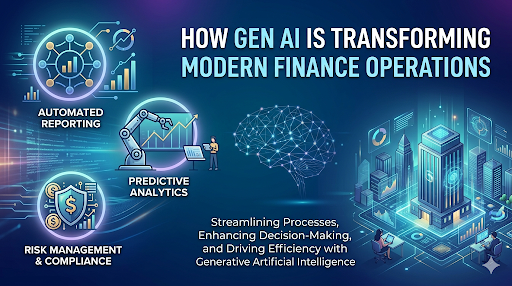

Finance organizations are under increasing pressure to deliver faster insights, improve forecasting accuracy and drive strategic value across the enterprise. Traditional finance processes, often reliant on manual effort and fragmented systems, are no longer sufficient to meet the demands of a rapidly evolving business environment.
Generative AI is emerging as a powerful enabler of this transformation. By automating complex tasks, enhancing analytics and improving decision-making, it is helping finance leaders move from transactional roles to strategic business partners.
Overview Of Gen AI In Finance
Generative AI refers to advanced artificial intelligence models capable of generating content, insights and recommendations based on large datasets. In finance, these capabilities extend across planning, reporting, compliance and operational processes.
Unlike traditional automation tools, generative AI can understand context, generate narratives and provide predictive insights. This makes it highly valuable for finance teams dealing with large volumes of structured and unstructured data.
Organizations adopting Gen AI in finance are focusing on embedding these capabilities into core finance processes such as financial planning and analysis, record-to-report and procure-to-pay. The goal is not just efficiency but also enhanced decision support and improved business outcomes.
Finance functions that successfully deploy generative AI typically align it with broader digital transformation initiatives, ensuring integration with enterprise systems, data governance frameworks and performance metrics.
Benefits Of Gen AI In Finance
1. Increased productivity and efficiency
Generative AI significantly reduces manual effort in finance operations. Tasks such as report generation, variance analysis and reconciliations can be automated or augmented with AI-generated insights.
This allows finance professionals to shift focus from routine activities to strategic analysis and business partnering.
2. Faster and more accurate decision-making
Finance leaders rely on timely and accurate data to make informed decisions. Generative AI can process vast datasets and generate real-time insights, enabling faster and more confident decision-making.
It also reduces the risk of human error, improving the reliability of financial reporting and forecasts.
3. Enhanced forecasting and planning
Traditional forecasting methods often struggle to account for dynamic market conditions. Generative AI enhances forecasting accuracy by analyzing historical data, identifying patterns and generating predictive models.
This enables more agile planning and better alignment with business strategy.
4. Improved compliance and risk management
Regulatory requirements continue to evolve, placing additional pressure on finance teams. Generative AI can assist in monitoring compliance, analyzing financial transactions and identifying anomalies.
It can also generate audit-ready documentation, improving transparency and reducing compliance risks.
5. Cost optimization
By automating processes and improving efficiency, generative AI helps reduce operational costs. It also identifies opportunities for cost savings by analyzing spending patterns and highlighting inefficiencies.
Finance organizations can achieve better cost control while maintaining high levels of accuracy and performance.
Use Cases Of Gen AI In Finance
1. Financial planning and analysis
1.1 Automated variance analysis
Generative AI can analyze financial performance data and automatically generate explanations for variances. This reduces the time required for manual analysis and improves the quality of insights.
1.2 Scenario planning and forecasting
AI models can simulate multiple business scenarios and provide recommendations based on potential outcomes. This supports more informed strategic planning.
2. Record-to-report processes
2.1 Automated financial reporting
Generative AI can create detailed financial reports, including narratives that explain key trends and insights. This enhances reporting efficiency and consistency.
2.2 Close process optimization
AI can identify bottlenecks in the financial close process and recommend improvements, helping organizations achieve faster close cycles.
3. Procure-to-pay and expense management
3.1 Invoice processing automation
Generative AI can extract, validate and process invoice data, reducing manual intervention and improving accuracy.
3.2 Spend analysis
AI can analyze spending patterns and identify opportunities for cost savings and supplier optimization.
4. Order-to-cash processes
4.1 Cash application automation
Generative AI can match payments to invoices and resolve discrepancies, improving cash flow management.
4.2 Credit risk assessment
AI models can evaluate customer creditworthiness using historical and external data, supporting better risk management.
5. Compliance and audit
5.1 Continuous monitoring
Generative AI enables real-time monitoring of financial transactions, identifying anomalies and potential compliance issues.
5.2 Audit support
AI can generate audit trails and documentation, simplifying audit processes and reducing preparation time.
Why Choose The Hackett Group® For Implementing Gen AI In Finance
Implementing generative AI in finance requires a structured approach that combines technology, process optimization and data governance. Organizations must move beyond experimentation and focus on scalable, value-driven deployment.
The Hackett Group® brings a research-based perspective to this challenge, leveraging benchmarking data and proven methodologies to guide finance transformation.
1. Benchmark-driven insights
The Hackett Group® is known for its extensive benchmarking research, which helps organizations understand performance gaps and identify high-impact opportunities for generative AI adoption.
This ensures that investments are aligned with measurable business outcomes.
2. Strategic and practical approach
As an experienced AI consulting company, The Hackett Group® provides both strategic guidance and practical implementation support. This includes use case identification, roadmap development and change management.
3. Governance and risk management
Generative AI introduces new challenges related to data privacy, compliance and ethical use. A structured governance framework helps organizations mitigate risks while maximizing value.
4. Scalable implementation
The Hackett Group® helps organizations scale generative AI initiatives across finance functions, ensuring integration with existing systems and alignment with enterprise strategy.
The Hackett AI XPLR™ platform further supports this journey by enabling organizations to explore, prioritize and implement AI use cases in a structured and efficient manner.
Conclusion
Generative AI is transforming finance from a transactional function into a strategic driver of business value. By automating processes, enhancing analytics and improving decision-making, it enables finance teams to operate with greater efficiency and agility.
However, realizing these benefits requires more than adopting new technology. Organizations must align generative AI initiatives with business strategy, establish strong governance frameworks and focus on measurable outcomes.
With the right approach and expert guidance, finance leaders can harness the full potential of generative AI to drive innovation, improve performance and deliver sustained competitive advantage.
