
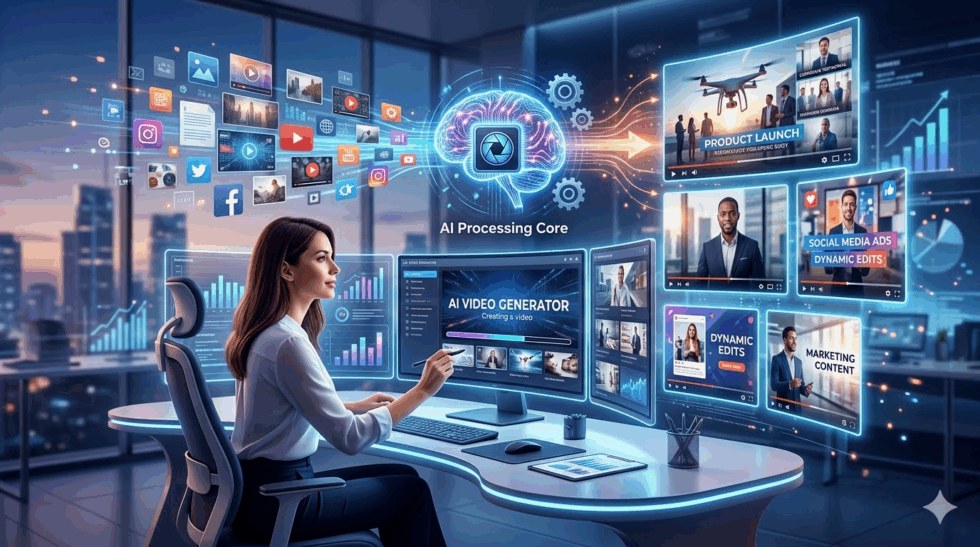

Modern brands are under pressure to produce more video content than ever before, and faster. Social clips, product explainers, ad creatives, campaign videos, and landing page content all compete for the same limited production resources. The challenge is not just volume. It is consistency, speed, and the ability to keep publishing without creating a bottleneck that slows down every other part of the marketing operation.
That is where AI video generators are starting to make a real difference.
Traditional video production can take days or weeks per asset. Scripting, filming or animating, editing, resizing for platforms, getting approvals, every step adds time. For teams running lean, that process creates delays that are hard to absorb. AI is changing the equation by compressing the time between concept and usable output, while making it easier to repurpose assets, build variations, and keep a consistent publishing pace.
Why Video Has Become Non-Negotiable for Brands
Video is no longer a nice-to-have format. It now sits at the centre of how brands communicate across awareness, education, conversion, and retention. Audiences expect it. Algorithms reward it. And for most brands, written content alone no longer does the full job.
The practical problem is scale. A brand running campaigns across LinkedIn, Instagram, YouTube, and paid channels cannot produce separate high-quality videos for each platform from scratch every time. The math does not work with traditional workflows. Something has to give, either the output quality, the publishing frequency, or the team size. AI is increasingly the answer that avoids making those trade-offs.
Where Traditional Production Falls Short
Traditional video production still has value. For high-stakes brand films, product launches, or flagship campaigns, studio-quality production is often worth the investment. But most marketing video content does not fall into that category.
Most brands need a steady supply of short, focused, on-brand video content, explainers, testimonials, social clips, ad variations, tutorial segments, and they need it regularly. Traditional production cycles are not designed for that kind of volume. The result is that teams either fall behind on content or spend a disproportionate amount of budget and time on assets that could be produced more efficiently.
The bottleneck is real. A campaign might be ready to go but waiting on a video. A product page might be live but missing an explainer. A social strategy might call for three format variations, but production resources only support one.
What AI Video Generators Actually Change
AI video tools do not replace creative strategy. What they change is the speed and flexibility at which teams can execute.
The most significant shift is the ability to go from a script or brief to a video draft much faster than before. That shortens feedback loops, makes it easier to test directions, and keeps projects moving. It also makes repurposing far more practical; a blog post, email campaign, or product description can become a video without treating it as an entirely new production project.
Other practical benefits include creating platform-specific versions from a single core asset, generating multiple ad creative variations for testing, producing tutorial and educational content at repeatable scale, supporting social content calendars with less manual effort, and reducing the production strain on small in-house teams.
For brands that publish regularly, this is significant. Video content stops being a production project and starts becoming a repeatable part of the content workflow.
The Tools That Are Making This Possible
The quality of AI video generation has improved substantially over the past year. Tools like AI video generator support text-to-video, image-to-video, and video-to-video workflows, meaning brands can start from a written prompt, an existing image, or raw footage and generate polished output in minutes. The platform integrates models like Google VEO, Kling, Runway, and Sora, giving teams access to different visual styles and motion qualities depending on the type of content they need.
Features like bulk generation, AI prompt enhancement, character consistency, and audio sync are now standard in professional-grade tools, capabilities that used to require specialist software and significant post-production time. The result is that a small marketing team can now produce content that would have required a production agency not long ago.
Speed Matters, but Workflow Matters More
The risk with any AI tool is treating it as a shortcut rather than a system. Fast output that lacks strategic direction, brand consistency, or editorial quality does not solve the underlying content challenge. It just creates more noise.
The brands that get the most out of AI video generation are the ones that build it into a proper workflow. That means connecting the tool to scripting, creative direction, review processes, and publishing logic. When AI video sits inside a real content system, rather than being used as a one-off fix, it starts supporting content operations rather than complicating them.
It also means being intentional about inputs. The quality of what goes into the generation process, prompts, reference images, scripts, style direction, directly shapes the quality of what comes out. Better inputs consistently produce better outputs.
Common Mistakes Brands Make
There are a few patterns that consistently undermine AI video results: using weak or vague prompts and expecting professional output; skipping the editorial review step and publishing first drafts; treating every video as a standalone project instead of building reusable templates; prioritising volume over message clarity; ignoring brand consistency across platform variations; and having no clear owner for the AI video workflow.
Most of these come down to the same issue. The team is using the tool, but nobody has designed the process around it. That gap between tool adoption and process design is where most AI video efforts stall.
What Better Video Production Actually Unlocks
When brands get AI video production working well, the benefits extend beyond faster output. Campaigns launch sooner. Content performs more consistently across channels. Teams spend less time on repetitive production tasks and more time on strategy and creative direction. Platform-specific variations become manageable rather than overwhelming.
More fundamentally, video stops being the asset that holds everything else up. When production velocity matches content strategy, brands can actually execute what they plan rather than scaling back because the video is not ready.
Conclusion
AI video generators are changing how modern brands produce content because they solve a genuine operational problem. Most brands need more video than their current production model can sustainably support. AI narrows that gap significantly, not by removing the need for creative thinking, but by removing the production friction that slows execution.
The brands that will benefit most are not those that simply adopt the tools, but those that build them into a real content workflow with clear ownership, strong inputs, and an editorial layer that keeps the output aligned with brand standards. That is when AI video generation stops being a shortcut and starts being a genuine advantage.
FAQ’s
1. What is an AI video generator?
An AI video generator is a tool that automatically creates videos from text prompts, images, or existing footage. Brands use it to produce social clips, product explainers, and ad creatives without a full production setup — cutting the time from idea to finished video from days to minutes.
2. How do AI video generators help small marketing teams?
AI video generators help small teams produce consistent video content without specialist editing skills or large budgets. Instead of outsourcing every asset, teams can go from a script or brief to a polished video quickly, making always-on content publishing realistic even with limited resources.
3. What types of videos can brands make with AI?
Brands use AI video generators to create social media clips, paid ad creatives, product explainers, landing page videos, tutorials, and campaign content. Tools like ImagineArt support text-to-video, image-to-video, and video-to-video — so brands can start from whatever assets they already have.
4. Can AI video generators create videos for different platforms?
Yes. AI video generators support multiple aspect ratios and resolutions, allowing brands to produce platform-specific versions, Instagram, YouTube, LinkedIn, from a single concept without starting from scratch each time.
5. Is AI-generated video professional enough for brand use?
Yes, when paired with clear prompts, strong creative direction, and an editorial review step. Tools running on models like Google VEO, Kling, and Runway can produce polished, on-brand output. The final quality depends more on the workflow around the tool than the tool alone.
