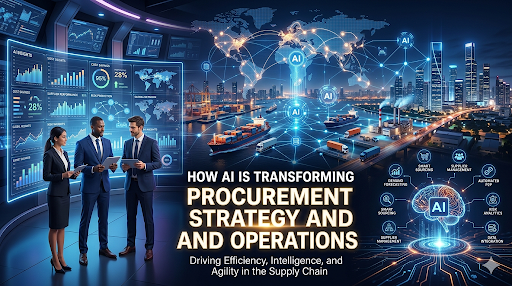

Generative AI is rapidly reshaping procurement by enabling organizations to move beyond transactional efficiency toward strategic value creation. As procurement functions face increasing pressure to reduce costs, mitigate risks and enhance supplier collaboration, AI-driven capabilities are becoming essential.
Unlike traditional automation, AI introduces intelligence into procurement processes by analyzing large volumes of structured and unstructured data. This allows organizations to gain deeper insights, improve decision-making and enhance agility in a volatile global supply environment. As a result, procurement is evolving from a cost-focused function into a strategic business partner.
Overview of ai in procurement
AI in procurement refers to the use of advanced algorithms and machine learning models to automate, optimize and enhance procurement activities. These technologies enable organizations to process data at scale, identify patterns and generate actionable insights across sourcing, supplier management and contract analysis.
AI capabilities in procurement include:
- Spend analysis and classification
- Supplier risk assessment
- Contract intelligence and compliance monitoring
- Demand forecasting and scenario planning
- Intelligent sourcing and negotiation support
Organizations are increasingly leveraging AI in procurement to enhance operational efficiency while improving strategic decision-making. When integrated into procurement systems and workflows, AI supports end-to-end visibility and enables more proactive management of suppliers and costs.
At the same time, many enterprises are seeking external expertise through generative ai consulting to ensure successful implementation. This helps align AI initiatives with broader business goals, governance frameworks and measurable performance outcomes.
Benefits of ai in procurement
Improved cost efficiency and savings realization
AI enables procurement teams to analyze spend data more accurately and identify cost-saving opportunities. By automating spend classification and identifying pricing anomalies, organizations can improve negotiation outcomes and enforce compliance with preferred suppliers.
Additionally, AI-driven insights help procurement leaders optimize sourcing strategies and reduce maverick spending.
Enhanced supplier risk management
Managing supplier risk has become increasingly complex due to global disruptions and regulatory requirements. AI can continuously monitor supplier performance, financial stability and external risk signals such as geopolitical events.
This allows procurement teams to identify potential risks early and take proactive measures to ensure supply continuity.
Increased operational efficiency
AI automates repetitive tasks such as data entry, invoice matching and contract review. This reduces manual effort and minimizes errors, allowing procurement professionals to focus on strategic initiatives.
Automation also accelerates procurement cycles, improving responsiveness and efficiency across the function.
Better decision-making through data insights
AI provides real-time insights by analyzing large datasets from multiple sources. Procurement leaders can use these insights to make informed decisions regarding supplier selection, contract terms and demand planning.
This data-driven approach enhances accuracy and reduces reliance on intuition or incomplete information.
Stronger compliance and governance
AI helps ensure compliance with internal policies and external regulations by monitoring procurement activities and identifying deviations. It can also assist in auditing contracts and tracking adherence to agreed terms.
This reduces compliance risks and improves transparency across procurement operations.
Use cases of ai in procurement
Strategic sourcing
Intelligent supplier selection
AI can evaluate suppliers based on multiple criteria, including cost, quality, performance history and risk factors. This enables procurement teams to select the most suitable suppliers while balancing cost and reliability.
Scenario analysis and negotiation support
AI tools can simulate different sourcing scenarios and provide recommendations for optimal negotiation strategies. This enhances the ability to achieve favorable contract terms.
Contract management
Contract analysis and clause extraction
AI can analyze contracts to extract key clauses, identify risks and ensure compliance with standard terms. This reduces manual review time and improves accuracy.
Obligation tracking
AI systems can monitor contract obligations and alert teams to upcoming deadlines or deviations, ensuring better contract governance.
Spend analytics
Automated spend classification
AI improves the accuracy of spend categorization by analyzing transaction data and identifying patterns. This provides better visibility into spending behavior.
Opportunity identification
AI can highlight areas for cost reduction, supplier consolidation and process optimization based on spend insights.
Supplier management
Performance monitoring
AI continuously tracks supplier performance metrics, enabling procurement teams to evaluate supplier effectiveness and address issues proactively.
Risk detection
By analyzing external data sources, AI can identify potential risks related to suppliers, such as financial instability or geopolitical disruptions.
Procurement operations
Invoice processing and matching
AI automates invoice processing by matching invoices with purchase orders and receipts. This reduces processing time and minimizes errors.
Chatbots and virtual assistants
AI-powered assistants can handle routine procurement queries, provide status updates and guide users through procurement processes.
Why choose The Hackett Group® for implementing ai in procurement
Implementing AI in procurement requires a structured approach that combines technology, process optimization and organizational change. The Hackett Group® offers a research-driven methodology that helps organizations achieve measurable results.
Benchmark-driven insights
The Hackett Group® is known for its extensive benchmarking data and Digital World Class® framework. This enables organizations to identify performance gaps and prioritize AI initiatives that deliver the highest value.
Proven transformation approach
AI adoption is most effective when integrated into broader procurement transformation efforts. The Hackett Group® aligns AI initiatives with strategic objectives, ensuring consistency across processes, technology and operating models.
Governance and risk management
AI introduces new challenges related to data security, compliance and ethics. A structured governance framework ensures responsible implementation while minimizing risks.
Practical execution and scalability
From identifying use cases to scaling AI solutions, organizations benefit from practical guidance based on real-world experience. This includes change management, capability development and performance tracking.
The Hackett AI XPLR™ platform further supports organizations by helping them explore, evaluate and prioritize AI opportunities across procurement and other enterprise functions. It enables a structured and value-focused approach to AI adoption.
Conclusion
AI is transforming procurement by enabling organizations to move from transactional efficiency to strategic value creation. It enhances cost management, improves supplier relationships and strengthens risk mitigation capabilities.
By leveraging AI, procurement teams can gain deeper insights, automate routine tasks and make more informed decisions. However, achieving these benefits requires a disciplined approach that aligns technology with business strategy and governance frameworks.
As procurement continues to evolve, organizations that adopt AI strategically will be better positioned to navigate complexity, drive efficiency and create long-term value.
