
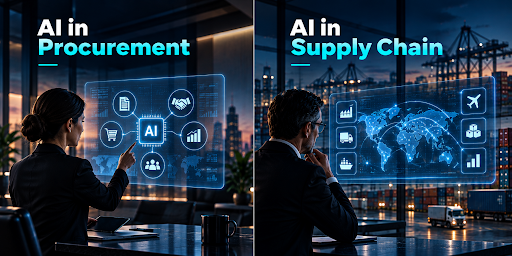

Organizations face growing pressure to improve operational efficiency, reduce costs and manage disruptions across increasingly complex supply networks. Procurement and supply chain functions play interconnected roles in achieving these objectives. AI in Procurement can strengthen sourcing, supplier management and purchasing decisions, while AI in Supply Chain can improve demand forecasting, inventory management, logistics and operational planning.
When implemented together, these technologies can help organizations improve visibility, automate repetitive activities and make more informed decisions across the end-to-end value chain. However, achieving sustainable results requires reliable data, integrated systems and clearly defined business priorities.
This article explores how AI in Procurement and AI in Supply Chain work together, their key applications, business benefits and priorities for successful implementation.
What is AI in Procurement?
AI in Procurement refers to the application of artificial intelligence across sourcing, purchasing, supplier management, contract analysis and procurement operations.
These capabilities include machine learning, predictive analytics, generative AI, intelligent automation and AI agents.
Procurement teams can use AI to classify spending, analyze supplier information, summarize contracts and identify potential risks.
Unlike conventional automation, AI can support knowledge-intensive activities involving interpretation and contextual analysis.
The objective is to improve procurement productivity, strengthen supplier decisions and support broader business performance.
What is AI in Supply Chain?
AI in Supply Chain refers to the application of artificial intelligence across demand planning, inventory management, manufacturing, logistics and fulfillment.
AI can analyze operational information, identify patterns, predict potential outcomes and recommend actions.
For example, intelligent technologies can help organizations forecast demand, evaluate inventory requirements and identify potential supply disruptions.
These capabilities can support faster decision-making while improving coordination across supply chain processes.
Why procurement and supply chain intelligence must work together
Procurement and supply chain decisions are closely connected.
Supplier selection affects material availability, production continuity and operating costs. Demand changes influence purchasing requirements, inventory positions and supplier capacity.
When functions operate through disconnected systems, organizations may struggle to understand these relationships.
AI in Procurement can provide better supplier and purchasing insights, while AI in Supply Chain can connect those insights with planning and operational requirements.
This creates opportunities for more coordinated decisions across sourcing, inventory, manufacturing and logistics.
Core technologies enabling intelligent operations
Several technologies contribute to AI-enabled procurement and supply chain management.
Machine learning
Machine learning analyzes historical and operational information to identify patterns across suppliers, spending, demand and inventory.
Predictive analytics
Predictive models can help organizations anticipate demand changes, supplier disruptions and operational risks.
Generative AI
Generative AI can summarize contracts, supplier information, planning reports and operational documentation.
Intelligent automation
Automation executes repetitive tasks and connects workflows across procurement and supply chain systems.
AI agents
AI agents can coordinate multistep activities across enterprise applications while operating within defined permissions and governance.
Together, these technologies expand the potential of AI in Procurement and AI in Supply Chain beyond traditional automation.
Key applications of AI in Procurement
Organizations can apply AI across several procurement processes.
Spend analysis
AI can classify transactions, identify spending patterns and improve visibility into purchasing activities.
Strategic sourcing
Intelligent analysis can support supplier evaluation, sourcing decisions and category management.
Contract management
Generative AI can summarize agreements, identify relevant clauses and retrieve contractual information.
Supplier risk management
AI can analyze supplier performance and external information to identify potential financial or operational risks.
Procurement operations
Intelligent automation can streamline requisitions, approvals and routine purchasing activities.
Supplier performance management
AI can identify performance trends and highlight suppliers requiring additional attention.
These applications demonstrate how AI in Procurement can improve both operational efficiency and strategic sourcing.
Key applications of AI in Supply Chain
Artificial intelligence can also improve several supply chain activities.
Demand forecasting
AI can analyze historical sales, seasonality and market signals to support more responsive forecasts.
Inventory optimization
Intelligent analytics can help organizations evaluate inventory requirements while balancing cost and service levels.
Supply planning
AI can support planning decisions involving materials, capacity and supply constraints.
Manufacturing
AI can assist with production planning, quality monitoring and predictive maintenance.
Logistics
Intelligent systems can support route optimization, transportation planning and disruption management.
Supply chain risk management
AI can analyze operational and external information to identify emerging risks.
These applications show how AI in Supply Chain can improve planning, execution and resilience.
Business benefits of AI-enabled procurement and supply chains
When connected to clear business objectives, intelligent technologies can create several benefits.
Greater operational productivity
AI can reduce repetitive administrative and analytical work, enabling employees to focus on higher-value activities.
Better cost management
Improved sourcing, planning and inventory decisions can help organizations identify cost optimization opportunities.
Stronger supply chain resilience
Predictive insights can help organizations identify potential supplier and operational disruptions earlier.
Improved inventory performance
Better demand and supply analysis can help organizations manage inventory while maintaining service requirements.
Faster decision-making
Integrated information can reduce the time required to investigate operational issues and evaluate alternatives.
How AI improves supplier and supply chain risk management
Supplier disruptions can affect inventory availability, manufacturing schedules and customer commitments.
AI in Procurement can help identify changes in supplier performance or emerging external risks.
AI in Supply Chain can then help evaluate which materials, production facilities or inventory positions may be affected.
Connecting these insights allows organizations to investigate potential disruptions and consider alternative sourcing or operational responses.
This approach can improve risk visibility while supporting more proactive supply chain management.
Best practices for implementing AI in Procurement and Supply Chain
Organizations can improve implementation outcomes by following several principles:
- Start with clearly defined procurement and supply chain problems.
- Establish current performance baselines.
- Improve supplier, spend, demand and inventory data quality.
- Integrate information across procurement and supply chain platforms.
- Prioritize AI use cases based on value, feasibility and risk.
- Simplify processes before introducing advanced automation.
- Establish cybersecurity, privacy and responsible AI controls.
- Maintain human accountability for strategic decisions.
- Prepare employees for AI-enabled workflows.
- Measure realized financial and operational outcomes.
These practices help organizations move beyond isolated AI applications toward coordinated transformation.
Common implementation challenges
Data fragmentation is a significant barrier because procurement and supply chain information often resides across multiple enterprise platforms.
Legacy systems can create additional integration challenges.
Organizations may also use inconsistent supplier, product and performance definitions, reducing the reliability of AI-generated insights.
Governance is another important consideration. AI applications may interact with confidential supplier information, pricing and commercially sensitive operational data.
Clear permissions, validation requirements and human oversight are essential for reliable implementation.
Measuring the value of AI investments
AI initiatives should be evaluated through improvements in business performance rather than technology usage alone.
For AI in Procurement, relevant measures can include sourcing cycle time, procurement productivity, contract compliance and supplier performance.
For AI in Supply Chain, organizations can monitor forecast accuracy, inventory levels, logistics costs, service performance and operational productivity.
Establishing baselines before implementation allows leaders to compare actual results with expected benefits.
This helps determine which AI applications should be expanded and which require further improvement.
The future of AI-enabled procurement and supply chains
The next phase of enterprise AI will increasingly involve intelligent agents capable of coordinating activities across procurement and supply chain systems.
An agent could identify a supplier issue, retrieve relevant information, evaluate potential operational implications and initiate an approved workflow.
Multiple agents may eventually coordinate activities across sourcing, planning, inventory and logistics.
As these capabilities mature, organizations will need to redesign processes, establish decision rights and strengthen governance.
The opportunity is to create more connected operations where employees and intelligent technologies work together to improve enterprise performance.
Conclusion
AI in Procurement and AI in Supply Chain are creating opportunities to improve sourcing, supplier management, planning, inventory and operational resilience.
Their greatest value emerges when intelligent capabilities are connected across the end-to-end value chain rather than implemented independently.
Organizations that combine reliable data, integrated technology, effective governance and measurable business objectives will be better positioned to build efficient, intelligent and resilient procurement and supply chain operations.
