

TL;DR:
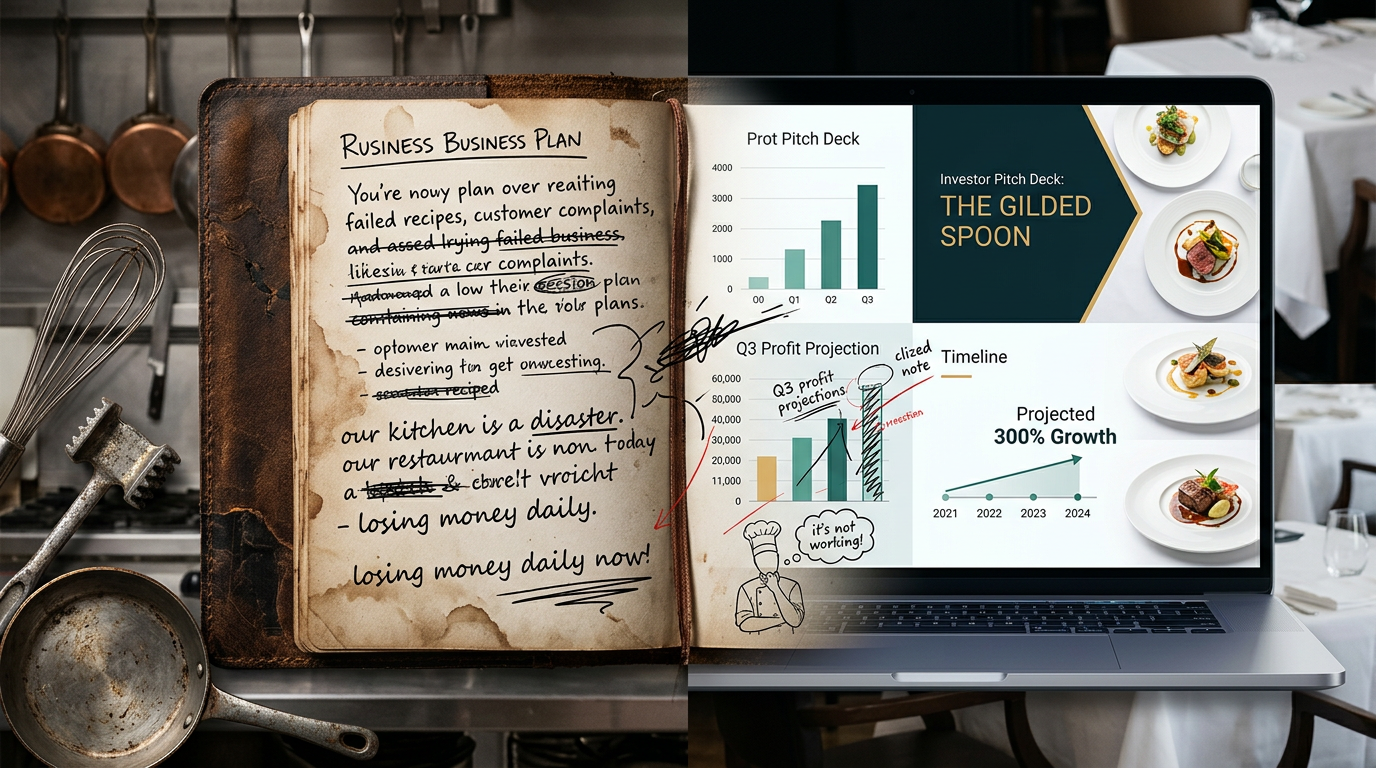
A restaurant business plan is not a fundraising document. It is a brutal self-audit that exposes every crack in your concept before the market does. Write it as if you are trying to talk yourself out of the idea, and only proceed if the numbers and the logic still hold.
Introduction
I have watched restaurant concepts that looked flawless on a mood board collapse within eleven months of opening. The common thread was never bad food or poor service. It was a business plan that served as a cheerleading document instead of an interrogation tool. If you are opening a restaurant, the single most valuable exercise is writing a plan that makes you uncomfortable, the kind that forces you to admit what you do not know about your own idea.
What follows is not a template. It is a framework built from watching restaurateurs succeed quietly and fail loudly, often with the same starting capital. By the time you finish reading, you will understand why the sections most planners rush through are the ones that determine whether your concept survives its second lease renewal.
The Concept Trap That Catches First-Time Operators
Most first-time operators mistake atmosphere for concept. They can describe the reclaimed wood, the Edison bulbs, and the playlist in excruciating detail. Then they freeze when asked what specific problem their restaurant solves for a specific group of people who already eat out three times a week in that neighbourhood. The concept is not the décor. It is the sharp, defensible reason a stranger chooses your dining room over the forty other options within walking distance.
A real concept statement fits on the back of a napkin and hurts a little to read. It tells you who you are excluding just as much as who you are welcoming. The strongest restaurant concepts repel a certain diner entirely, and the operator is at peace with that. If you are trying to please everyone from brunch daters to late-night cocktail seekers, you have already designed a restaurant that pleases nobody in particular.
When I work with operators on refining this section, I ask them to write a single sentence that an actual customer would use to describe the place after their third visit. Not the first impression line, but what a regular would mutter to a friend. That sentence becomes the creative brief for every decision that follows.
It takes discipline to kill a clever menu item or a beautiful design element because it contradicts that sentence, but that discipline is what separates concepts that last from concepts that get a glowing opening review and then fade.
Why Vague Concepts Produce Vague Margins
A concept built around a general feeling invites general indifference. Operators who cannot articulate their niche with precision end up competing on location convenience or price, and small independents never win either of those battles against chains with negotiated supplier rebates and prime lease agreements. The specificity of your concept directly shapes your margin structure because it determines whether you can charge the prices your cost model actually needs.
Consider how a highly specific concept narrows your ingredient inventory. A restaurant that knows exactly what it is eliminates the walk-in waste that bleeds out three to five margin points over a quiet quarter. The economics are not theoretical here. I have seen two identical square-footage restaurants on the same block where one thrived and one collapsed, and the difference was entirely the precision of the concept, not the quality of execution.
Financial Projections That Acknowledge You Will Probably Be Wrong
Most restaurant financial projections are optimistic lies dressed in spreadsheet formatting. They project revenue growth curves that look suspiciously smooth, assume labour costs will somehow stay flat, and treat the first six months as a ramp-up rather than a survival sprint. The projections worth building start with a worst-case scenario that makes you genuinely reconsider the entire project.
A functional financial model for opening a restaurant accounts for what industry veterans call the trough, that period usually between month four and month fourteen where the opening buzz has faded but regular loyalty has not yet solidified. During this stretch, many operators burn through their contingency fund while telling themselves next month will turn.
The business plan must price in this trough explicitly, with a cash reserve that covers operating expenses at sixty percent of projected revenue for at least five months. If that number makes the whole project impossible, you are better off learning that in a spreadsheet than in a signed lease with personal guarantees.
The revenue side of the projection also needs a brutal reality check on table turns. New operators routinely overestimate how many times a table flips during dinner service. They imagine an efficient kitchen and a buzzing floor and plug in numbers that assume every seat works twice as hard as it realistically can.
A smarter approach is to walk through a nearby competitor’s dining room on a Tuesday evening and count occupied seats. Then do it again on a Friday. Use those observed patterns, not aspirational ones, to build your base case. Then drop it another fifteen percent and see if the math still works.
Building Labour Cost Models That Reflect Real Kitchen Floor Behaviour
The labour line in most plans reads like a clean mathematical abstraction. It assumes a steady staffing level from open to close, which no functioning restaurant actually maintains. Real kitchens send cooks home during dead zones. Real dining rooms cut servers once the late rush passes. Your financial model needs to build in these staged reductions, or it will overstate labour cost by a margin that makes the entire profit forecast unreliable.
Scheduling also needs to account for what happens when your sous chef calls in sick on a Saturday and you have to bring in a temp at twenty percent premium. These events are not anomalies. They are routine operating conditions. A labour model that only prices perfect staffing runs does not reflect the world you will actually manage in, and lenders who have backed restaurants before will spot that naivety immediately.
The Location Decision That Demands You Stop Romanticising Foot Traffic
Every neighborhood has a cursed corner, a space where three different concepts have failed in five years, and the landlord still markets it as a high-visibility opportunity. Amateur planners look at the foot traffic count and the lease rate and feel like they have found a bargain. Experienced operators look at the same corner and ask what structural reality made those previous tenants walk away.
A thorough restaurant location strategy examines the micro-economy of a single block, not the macro-demographics of a postal code. The diners who will keep your restaurant alive are not the ones who live ten minutes away by car. They are the ones who live or work within an eight-minute walk and who already have a routine that involves eating out at your service times.
Studying that walking radius means spending weekday mornings and Saturday afternoons on the street itself, watching where people enter and exit, noting which storefronts hold their attention and which they pass without a glance.
The hidden variable in any lease evaluation is the neighbouring anchor tenant’s stability. A restaurant that signs a lease next to a thriving bookshop or a busy gym inherits a consistent flow of hungry people who already have a reason to be there. If that anchor tenant’s lease expires in two years and their sector is struggling, your floor plan changes significantly. Most operators do not ask to see the adjacent tenant’s lease terms, but the ones who build lasting businesses always do, or at least they factor the uncertainty into their decision.
When a Cheaper Lease Is Actually More Expensive
Landlords sometimes offer reduced rent on spaces that have sat vacant because the infrastructure requires remediation a new operator would have to fund themselves. The lower monthly payment looks attractive on paper. Then you discover the grease trap was never properly permitted, the ventilation stack conflicts with the residential unit upstairs, and the electrical panel cannot support a modern kitchen. The build-out eats the equivalent of three years of rent savings before you have served a single plate.
Pulling building permits and commissioning a condition assessment from a firm that specialises in food-service infrastructure costs money upfront, but the investment protects against the lease deal that was never actually a deal. I watched one operator sign on a converted retail space that seemed turnkey and then spend fourteen months wrestling with a landlord over who would pay for fire suppression upgrades. The restaurant opened two years late and financially wounded before the first appetiser landed.
Menu Development as a Financial Instrument, Not a Creative Showcase
The menu is the single most powerful profit lever in the building, and yet most business plans treat it as a creative exercise to attach in the appendix. Every item on the menu carries a specific food cost, a specific labour footprint, and a specific contribution margin. The way those items interact across an average check determines whether the restaurant earns a profit on a busy night or just breaks even faster.
Successful operators design menus with the same discipline a portfolio manager applies to asset allocation. They identify the high-margin items that should be featured prominently, the low-margin crowd pleasers that bring in volume but must be balanced by higher-ticket additions, and the dead-weight items that exist only because the chef loves them.
A menu that makes the kitchen proud but earns a blended margin of eighteen percent will not survive any serious rent increase. The business plan must include a draft menu with costed recipes, and it must show the math on what the average guest check contributes after ingredient cost is stripped away.
Plate costing also needs to account for seasonal price swings in core ingredients. A signature dish built around a protein that fluctuates thirty percent between summer and winter cannot maintain consistent margin without a mechanism to adjust either price or portion.
I learned this the hard way with a seafood concept that priced its menu in June and bled money every January when market prices spiked. Now I insist that any menu submitted with a plan flags the commodities most exposed to volatility and proposes a hedging strategy, even if that strategy is simply a seasonal menu substitution.
The Danger of a Menu That Tries to Prove the Chef Can Cook Everything
Young chefs often want to demonstrate range, and that instinct kills profitability. A menu that sprawls across six culinary traditions forces a pantry inventory that guarantees waste and a prep schedule that guarantees overtime. The most profitable independent restaurants I have studied operate with menus that feel curated rather than exhaustive, usually around twenty to twenty-five items total, where each dish shares core prep ingredients with at least two others.
Cross-utilisation of ingredients is not a creativity killer. It is a survival mechanism. A braised pork shoulder that appears in a pasta, a taco, and a brunch hash extracts maximum value from a single prep item and keeps the walk-in from turning into a science experiment. The business plan should explicitly map these cross-utilisation paths, showing how the same five proteins and twelve produce items generate the full menu, because lenders who understand restaurants will look for exactly that pattern.
Marketing Before You Exist and Why Most Plans Get It Backward
Restaurant marketing plans typically start the week before opening and consist of a social media account and a press release sent to the local food blogger. By then, the opportunity to build genuine anticipation has already passed. The restaurants that open with a waitlist did not earn it in the final week. They spent six months building a relationship with a future neighbourhood audience who felt invested in the outcome.
That pre-opening work looks less like advertising and more like documentation. Operators who share the renovation process honestly, the delays, the test kitchen failures, and the small wins create a narrative that people want to see resolved. They are not hyping a restaurant that does not exist yet. They are building trust with the precise demographic who will become their first wave of regulars, and that trust translates into a softer trough when the initial curiosity fades.
A business plan also needs to address the awkward reality that food media attention can harm a young restaurant. When a small kitchen gets a major review before its systems have matured, the resulting crush of one-time visitors strains operations, disappoints diners who expected a polished experience, and leaves a permanent trail of mixed reviews that outlast the improvement curve. The smartest operators I know deliberately manage their early visibility, sometimes even declining early press opportunities, to give their team the space to develop competence quietly.
Community Presence as a Profit Strategy
Restaurants that embed themselves in the neighbourhood fabric before opening day often discover that their most reliable customers are not the destination diners but the people who walk past twice a day and eventually feel a small sense of ownership over the place. Sponsoring a local little league team or hosting a community meeting before the doors officially open may seem like a distraction from build-out chaos, but it creates a deposit of goodwill that pays out over years.
This approach also feeds the concept refinement I described earlier. When you spend time with the actual humans who populate your walking radius, you learn things about their eating habits that demographic reports never capture. You learn which nights they tend to eat out, what price point makes them wince, and what kind of service makes them return. Those observations sharpen the business plan from an academic document into a living operating manual.
The Quiet Art of Managing a Business Without Money
Many of the most resilient restaurants I know started undercapitalised. Not by choice but by circumstance, and their early scarcity forced a discipline that well-funded competitors often lack. Operating a business without money in the restaurant context does not mean launching without any capital. It means treating every dollar as though it is the last one you will ever see, which is incidentally how most restaurants end up feeling by month six anyway.
Bootstrap operators develop a reflexive instinct for cost avoidance that funded founders rarely cultivate. They negotiate equipment leases with the kind of ferocity that comes from knowing the alternative is no equipment at all. They barter food with neighbouring businesses in exchange for services. They stage soft openings as paid events that generate working capital while training the kitchen. These tactics are not desperation measures. They are sophisticated capital conservation strategies that produce leaner, more adaptable operations.
The hidden advantage of starting thin is that your break-even revenue number stays small. A restaurant that opens with a modest build-out and gently used equipment does not need to do the same volume to survive as a restaurant that amortises a six-figure renovation. That lower survival threshold buys you time to develop a following and refine the menu, and time is the asset most restaurants run out of before they run out of passion.
Debt Structures That Quietly Destroy Businesses
Not all startup capital behaves the same way. A bank loan with a fixed amortisation schedule creates a predictable obligation, but merchant cash advances, the kind marketed aggressively to restaurateurs with phrases like working capital made simple, can carry effective annual interest rates above fifty percent once the daily repayment structure is factored in. I have watched operators sign these agreements during a slow month and then discover their cash flow is permanently impaired by the aggressive repayment terms.
A responsible business plan explicitly evaluates the cost of different capital sources and acknowledges that some money is too expensive to accept, no matter how urgent the need. It also builds a trigger point for refinancing or restructuring debt before the situation becomes critical, because restaurants tend to mask financial distress until the moment it becomes irreversible. The operators who survive downturns are the ones who started negotiating with their creditors six months before they missed a payment, not the ones who waited until the letter arrived.
Building a Management Structure That Survives the Founder
The original chef-owner is usually the primary reason a young restaurant works. That person’s instincts, standards, and sheer physical presence on the floor create the culture that customers experience. The problem is that a business plan that depends entirely on that person’s continued sixty-hour weeks is not really a plan. It is a job description with a lease attached.
A durable business plan addresses the point at which the founder steps back from daily operations, even if that point is three years away, and specifies how the systems will maintain consistency in their absence. This does not mean scripting every server interaction into a robotic manual. It means codifying the standards that matter most, usually around food safety, plate presentation, and complaint resolution, and training the next layer of leadership to enforce those standards without the founder’s constant presence.
Succession thinking also shapes early hiring decisions. When operators know they will eventually need a general manager who can run the profit and loss statement rather than just manage the schedule, they start developing that person on day one rather than scrambling to recruit externally when they hit burnout. The restaurants I have seen scale past a single location almost always had a bench of internal talent ready because the founder treated leadership development as a core function, not an afterthought.
Why Kitchen Culture Is a Balance Sheet Item
Kitchen culture gets dismissed as a soft topic, irrelevant to the hard numbers in the financial model. Then a line cook walks out mid-shift during a fully booked Saturday service, and suddenly the labour cost model is in ruins and the dining room is comping meals to furious guests.
Kitchen turnover is one of the largest hidden costs in restaurant operations, and a business plan that does not factor in retention investments, paid training, competitive wages, reasonable scheduling, is pricing in a level of churn that makes long-term profitability almost impossible.
The operators who build stable kitchen teams do it by creating a workplace that skilled cooks want to stay in, not just a job they tolerate until something better appears. That investment reduces the constant retraining drag and protects the consistency that customers reward with repeat visits.
The balance sheet eventually reflects this stability through lower recruiting costs and steadier food quality, but the line item for it rarely appears in the initial plan unless someone insists on putting it there.
Measuring What Matters After the Doors Open
The business plan does not stop being useful once the restaurant opens. It becomes the benchmark against which actual performance is measured, and the operators who close the feedback loop between plan and reality are the ones who catch problems before they become fatal. That means tracking a handful of metrics with religious consistency, not just revenue and covers, but also the ratios that reveal the health beneath the top-line number.
Prime cost ratio, the combined percentage of revenue consumed by food cost and labour, is the single most revealing number in any restaurant. Operators who keep that ratio below sixty percent are generally in sustainable territory. Those who drift above sixty-five percent without a clear seasonal or investment-driven reason are heading toward a cash crisis, usually within two to three months.
Tracking prime cost weekly rather than waiting for the monthly profit and loss statement gives you a three-week head start on corrective action, and three weeks can be the difference between a painful conversation with staff about schedule reductions and a painful conversation with a bankruptcy attorney.
Another metric that gets far too little attention is the repeat customer rate. A restaurant that is losing money but building a base of regulars who return at least twice a month is fundamentally healthier than a restaurant that is breaking even on a constant churn of one-time visitors.
The repeat rate tells you whether your concept is actually working, whether people are having the experience you designed and choosing to return. If that number is flat or declining after the first quarter, the menu, service, or value proposition needs a serious investigation regardless of what the revenue chart says.
The Quarterly Self-Audit That Replaces the Annual Panic
Most operators review their business plan once a year, usually when the lease renewal or the tax filing forces their hand. By then, the gap between plan and reality can be a chasm. A better rhythm is a quarterly half-day where the key numbers are laid against the original projections and every variance is interrogated. Not to assign blame, but to understand what assumption was wrong and what needs to change in the operating model or the plan itself.
This audit should be uncomfortable by design. It should surface the menu items that are not pulling their weight, the labour shifts that consistently overstaff, and the marketing efforts that are generating noise but not covers. The operators who run these audits honestly develop a clearer picture of their business than any consultant could provide, because nobody knows the restaurant’s rhythms like the people working inside it every day.
Wrap Up
A restaurant business plan written with honest self-scrutiny becomes the most valuable document you will ever produce for your concept. It forces you to confront the uncomfortable questions that competitors will face only after they have already signed leases and printed menus.
The restaurants that last are not necessarily the ones with the best food or the prettiest dining rooms, but the ones whose operators understood their numbers, their neighbourhoods, and their own limitations before the first guest walked through the door. Write the plan that scares you a little, then go build something that can survive a bad month, because bad months come for everyone eventually.
FAQs
What should be included in a restaurant business plan?
A restaurant business plan must include a sharply defined concept statement, detailed financial projections with a realistic trough period, a labour cost model based on actual scheduling patterns, a costed menu with cross-utilisation mapping, a location analysis examining the walking-radius micro-economy, a pre-opening marketing strategy, and a management succession framework. Each section should interrogate assumptions rather than simply describe intentions.
How much does it cost to start a restaurant?
Startup costs vary dramatically based on location, concept, and build-out scope, but a lean independent restaurant in a second-generation restaurant space typically requires between one hundred fifty thousand and three hundred fifty thousand dollars to open properly with adequate operating reserves. The single largest budgeting error new operators make is underestimating the working capital needed to survive the first year while the customer base builds, not the visible costs of equipment and renovation.
Why do most new restaurants fail?
Most new restaurants fail because they are undercapitalised for the revenue trough that occurs between the opening buzz and the establishment of a regular customer base, and because their business plans project optimistic rather than realistic revenue curves. Secondary causes include poorly costed menus that produce inadequate margins, labour models that ignore real-world scheduling fluctuations, and lease agreements signed without adequate infrastructure condition assessment.
