
The UK tech industry is no longer playing it safe. With digital transformation accelerating across financial services, healthcare, retail, and public sector organisations, businesses are demanding professionals who can deliver results — fast, flexibly, and without burning out their teams. That is precisely why the CSM Course has become one of the most sought-after credentials in British professional circles right now. Platforms like StarAgile are seeing a sharp spike in enrolments from UK-based professionals who are done waiting for a promotion that never comes and ready to make a deliberate career move instead.
So what exactly is happening in the UK market? And why is 2026 the year to act?
The UK Tech Job Market Has Changed — Permanently
A few years ago, having a technical degree or a string of tools on your CV was enough to stand out. That era is over. Employers across London, Manchester, Edinburgh, and Bristol are now prioritising something different: the ability to lead teams through ambiguity, manage stakeholder expectations, and ship value in short, measurable cycles.
This is the Agile way of working. And the Certified ScrumMaster (CSM) is the qualification that proves you can operate within it.
According to recent hiring data, Scrum Master roles in the UK have grown by over 30% year-on-year, with average salaries ranging from £55,000 to £90,000 depending on industry and seniority. More notably, these roles are no longer confined to software companies. Banks, NHS trusts, consultancies, and even government departments are actively hiring CSMs.
What StarAgile’s CSM Course Actually Teaches You?
Many professionals assume a CSM Course is only for developers or IT project managers. That assumption is costing people opportunities.
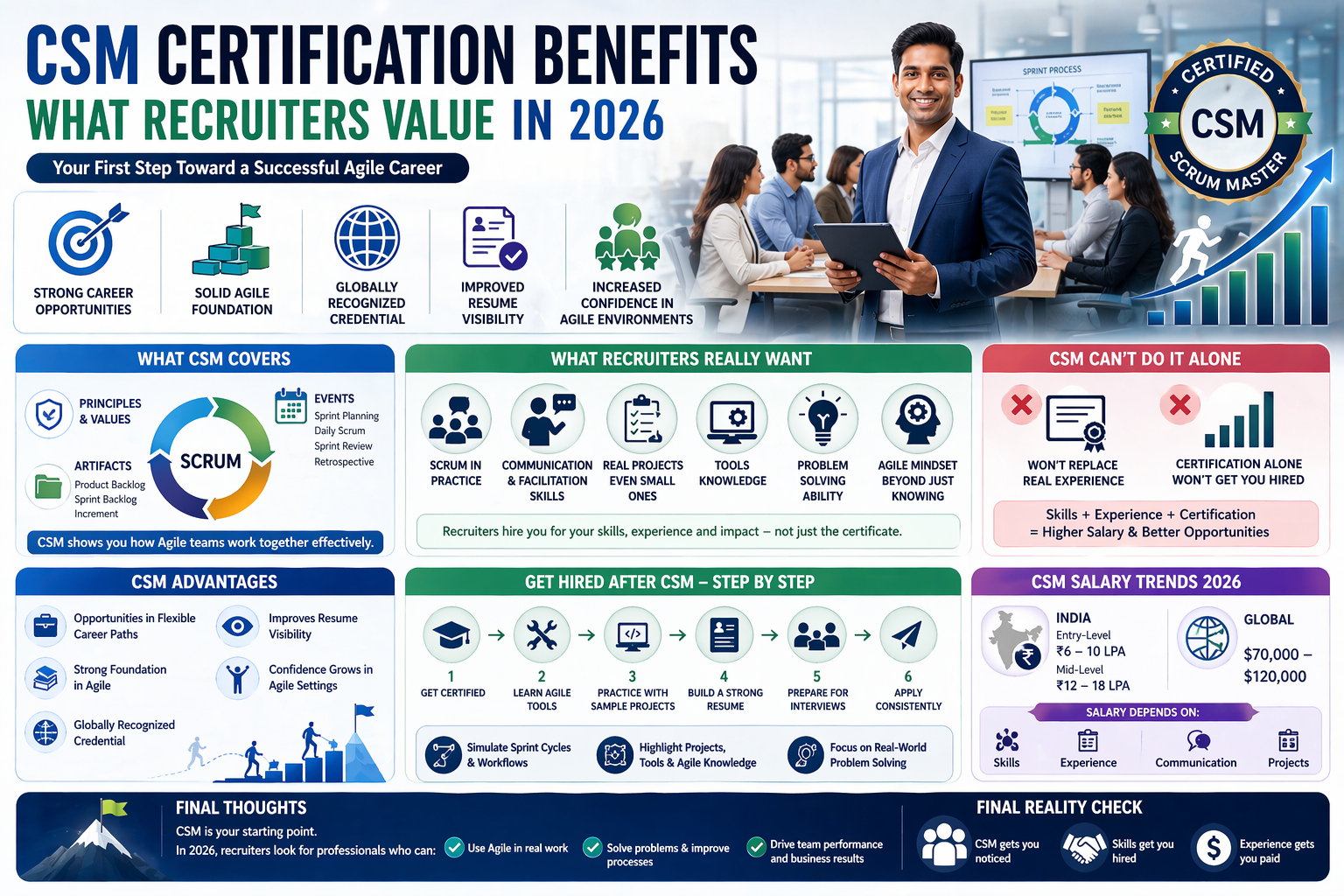
StarAgile’s CSM curriculum is built around practical Scrum principles — how to facilitate sprints, remove blockers, coach cross-functional teams, and create a culture of continuous improvement. Whether you come from a marketing background, operations, finance, or product management, the skills transfer directly.
Here is what a solid CSM Course covers:
- Scrum Framework Fundamentals — roles, events, artefacts, and the underlying values that make Scrum work
- Sprint Planning and Retrospectives — running meetings that are genuinely useful, not just ticking boxes
- Servant Leadership — a style of management that UK organisations, particularly post-pandemic, are actively looking for
- Stakeholder Communication — translating team progress into language that executives and clients actually understand
- Agile Mindset Coaching — helping teams move from rigid processes to adaptive thinking
Why Scrum Master Certification in UK Is Gaining Serious Momentum?
The demand for Scrum Master Certification in UK is not just coming from individuals. Organisations themselves are sponsoring employees to get certified. This is a meaningful shift. When companies start paying for upskilling rather than waiting for candidates to arrive certified, it signals that the credential has crossed from “nice to have” into “standard requirement.”
Several trends are driving this:
Remote and hybrid work culture — Scrum provides the structure that distributed UK teams need. Without clear ceremonies and defined roles, remote collaboration tends to deteriorate into email chains and missed deadlines.
Post-Brexit project complexity — UK businesses managing supply chains, compliance frameworks, and technology migrations outside EU structures are leaning on Agile delivery to stay responsive.
The rise of AI-adjacent roles — As AI tools are embedded into product and operations workflows, organisations need Scrum Masters who can manage iterative AI implementation — a niche that is genuinely new and genuinely lucrative.
Who Is Actually Enrolling in a CSM Course in 2026?
The profile of a CSM learner in the UK has diversified considerably. It is no longer just the mid-career software professional. Current cohorts include:
- Graduate professionals entering tech from non-traditional backgrounds
- Project managers looking to transition from waterfall to Agile delivery
- Team leads in banking and insurance who want formal credentials behind their existing experience
- Career changers from teaching, healthcare administration, and retail management — sectors that are feeding talent into UK tech at a surprising rate
The common thread is not background. It is intention. These are people who have decided that 2026 is the year they stop drifting and start directing.
The ROI of Getting Certified Now
The CSM certification, awarded by the Scrum Alliance, does not expire immediately — but it does require renewal, which keeps certified professionals current and credible. The two-day intensive format means most UK professionals can complete the course without taking extended leave, and online options have made it accessible from any city.
For the salary uplift alone — frequently reported at 20–40% post-certification — the return on investment is straightforward.
Final Thought
The UK’s Agile economy is not slowing down. If anything, 2026 is the year it becomes the default rather than the exception. A CSM Course is not a shortcut — it is a structured, globally recognised path into roles that pay better, matter more, and offer real leadership responsibility. The professionals enrolling today are not just keeping up with the market. They are positioning themselves ahead of it. With StarAgile’s industry-led CSM training, expert mentorship, and globally recognized certification support, you are not just preparing for a role — you are preparing to lead.
