
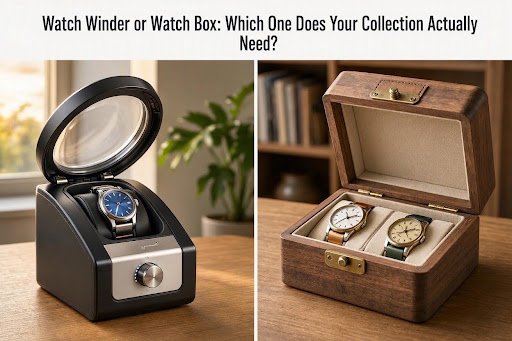

Anyone who owns more than one automatic watch eventually asks the same question: do I need a winder, a box, or both? The answer isn’t as simple as picking whichever looks nicer on a shelf. It depends on how many watches you own, how often you wear them, and how much you value not resetting the date every Monday morning.
This guide walks through exactly how each option works, who benefits from which, and how to build a storage setup that actually protects your watches rather than just displaying them.
Why Automatic Watches Need Special Care in the First Place
Automatic (self-winding) watches run on kinetic energy generated by your wrist movement. A rotor inside the case spins as you move, winding the mainspring and keeping the watch powered. Take the watch off for a day or two, and that energy runs out. The watch stops.
This isn’t a flaw. It’s simply how mechanical movements have worked for over a century. The inconvenience only shows up when you own more watches than wrists to wear them on.
Once a watch stops, you’re not just dealing with a dead battery scenario. You have to reset the time, the date, and on some models, the day, moon phase, or other complications. For a simple three-hand watch, that’s a minor annoyance. For a perpetual calendar or a watch with a complicated date-setting sequence, it can take real effort to get everything realigned correctly.
What a Watch Winder Actually Does
A watch winder is a motorized box that gently rotates a watch on your behalf, mimicking the wrist motion that would normally keep it powered. Place the watch in the winder, set the rotation direction and daily turn count to match the movement’s specifications, and the watch stays wound and ready to wear.
Winders matter most for:
- Multi-watch owners who rotate between several pieces and don’t wear each one daily.
- Complicated watches where resetting the date, moon phase, or GMT function is genuinely time-consuming.
- Perpetual calendars, which can take months to correct if allowed to fully stop, since some models only display the correct date once every four years without intervention.
- Anyone who wants a watch ready to grab and wear, without waiting for it to build up power reserve first.
If you’re building a collection of three or more automatics, a single-watch winder stops being practical fairly quickly. That’s where multi-watch winders come in — they let you keep several pieces running simultaneously, each with independent rotation settings, so a GMT and a simple three-hander can sit side by side without one being over-wound or under-serviced by the wrong program.
What a Watch Box Actually Does
A watch box, by contrast, isn’t motorized. It’s a storage solution built around protection, organisation, and presentation. Good watch boxes typically include a soft cushion or pillow for each watch, a lid to keep out dust and light, and in many cases a lock for security.
Watch boxes matter most for:
- Manual-wind watches, which don’t benefit from a winder at all since they’re wound by hand, not by rotor motion.
- Watches you wear frequently, where keeping them wound isn’t really the issue — you just need somewhere safe to put them overnight.
- Vintage pieces, where movement inside a spinning winder isn’t always advisable, particularly with older lubricants or fragile components.
- Collectors who care about display, since a well-made box often doubles as a way to show off a collection to guests or simply enjoy looking at it.
Choosing the right box isn’t just about size and slot count. Material, cushion fit, humidity control, and even the type of finish on the interior all affect how well a watch is protected over years of storage. This detailed guide on time and shine, choosing the perfect explained breaks down exactly what separates a genuinely protective box from one that just looks good in photos.
Watch Winder vs Watch Box: The Real Difference
The core distinction comes down to function versus storage.
A winder keeps an automatic watch powered and set correctly. A box keeps any watch — automatic, manual, or quartz — safe, clean, and organised. Neither one replaces the other, because they solve different problems.
Here’s a simple way to think about it:
| Situation | Winder | Box |
| You own 1–2 automatics you wear most days | Not essential | Ideal |
| You own 3+ automatics in rotation | Recommended | Also needed for the rest |
| You own complicated watches (GMT, perpetual calendar) | Highly recommended | Still useful for off-duty pieces |
| You own manual-wind or quartz watches | Not applicable | Ideal |
| You want display and protection combined | Not the main purpose | Ideal |
Most serious collectors end up owning both. The winder handles the automatics currently in rotation. The box holds everything else — watches resting, watches waiting to be worn, and pieces that simply don’t need to stay wound.
How Many Slots Do You Actually Need?
A common mistake is buying a winder or box sized for the collection you have today, rather than the one you’re building toward. If you already own four automatics and plan to add more within the next year or two, it’s worth buying slightly larger than your current count.
A few practical guidelines:
- Count your current automatic watches, then add at least one or two slots for near-future additions.
- Separate winders from static storage. Not every watch needs to be winding constantly — overwinding isn’t physically possible with a modern automatic movement, but running a watch you rarely wear adds unnecessary mechanical wear over years.
- Consider independent rotation settings if your watches have different movement specifications (turns per day and direction vary by brand and model).
- Leave room in your box for watches temporarily out of the winder — during servicing, travel, or simply when you’re wearing something else.
Setting Up a Winder Correctly
Getting the settings wrong is one of the most common mistakes new winder owners make. Each automatic movement has a manufacturer-recommended turns-per-day (TPD) figure and rotation direction (clockwise, counter-clockwise, or bidirectional). Running a watch on the wrong setting won’t damage it outright, but it can lead to under-winding, where the watch still stops despite sitting in the winder.
Before placing a watch in a multi-watch winder, check the manufacturer’s specifications or the watch’s manual for its correct TPD and direction. Most winders let each slot run independently, so a Rolex on bidirectional rotation and an Omega on clockwise-only can sit right next to each other without conflict.
For a deeper technical explanation of how automatic movements are constructed and regulated, the British Horological Institute publishes reliable, non-commercial resources on watch mechanics that are worth a read if you want to understand what’s actually happening inside the case.
Protecting Your Investment Long-Term
Whether you lean toward a winder, a box, or both, a few habits protect a collection regardless of setup:
- Keep watches away from direct sunlight and extreme temperature swings, which can affect lubricants and gaskets over time.
- Avoid stacking watches directly on top of each other without cushions, since this can scratch cases and crystals.
- Service automatic movements roughly every 4–5 years, even if they’ve been sitting in a winder the whole time. Winders keep a watch running; they don’t replace servicing.
- Store winders and boxes away from strong magnetic fields (speakers, laptops, some kitchen appliances), since magnetism can affect movement accuracy.
Final Thoughts
There’s no single right answer to the winder-versus-box debate, because they’re not really competing for the same job. A winder solves the specific problem of keeping automatic watches powered and correctly set. A box solves the broader problem of protecting and organising a collection, automatic or otherwise.
If you’re only just starting out with one or two watches, a well-made box is usually the more immediately useful purchase. Once your collection grows past two or three automatics — or once you own a complicated piece that’s genuinely painful to reset — a winder starts paying for itself in convenience. Most collections, given enough time, end up needing both. You can browse the full range of storage and winding solutions at Aevitas to find a setup that matches where your collection is today, and where it’s likely headed next.
FAQs
Do watch winders damage automatic watches? No, not when used correctly. Modern automatic movements have a slipping clutch mechanism that prevents overwinding. Damage typically only occurs if the winder’s rotation settings badly mismatch the watch’s specifications over a long period, which is why checking TPD and direction before use matters.
Can I put a manual-wind watch in a winder? No. Manual-wind watches don’t have a self-winding rotor, so a winder has nothing to engage. These watches need to be wound by hand through the crown and are better suited to a standard watch box.
How often should I run my watch winder? Most collectors run winders continuously for watches currently in rotation, or set them on a timed cycle (a few hours a day) to simulate regular wear without unnecessary mechanical strain. Continuous running is generally safe for modern movements, but check your specific watch’s guidance if you’re unsure.
What’s the difference between a watch box and a watch case? The terms are often used interchangeably, though “watch box” more commonly refers to a dedicated storage unit with multiple slots, while “watch case” can also describe a smaller travel case or the outer shell of the watch itself. Context usually makes it clear which is meant.
Is it worth buying a winder for just one watch? It depends on the watch. For a simple three-hand automatic you wear most days, a single-watch winder is often unnecessary. For a complicated piece like a perpetual calendar, even one watch can justify a winder simply to avoid a lengthy resetting process every time it stops.
