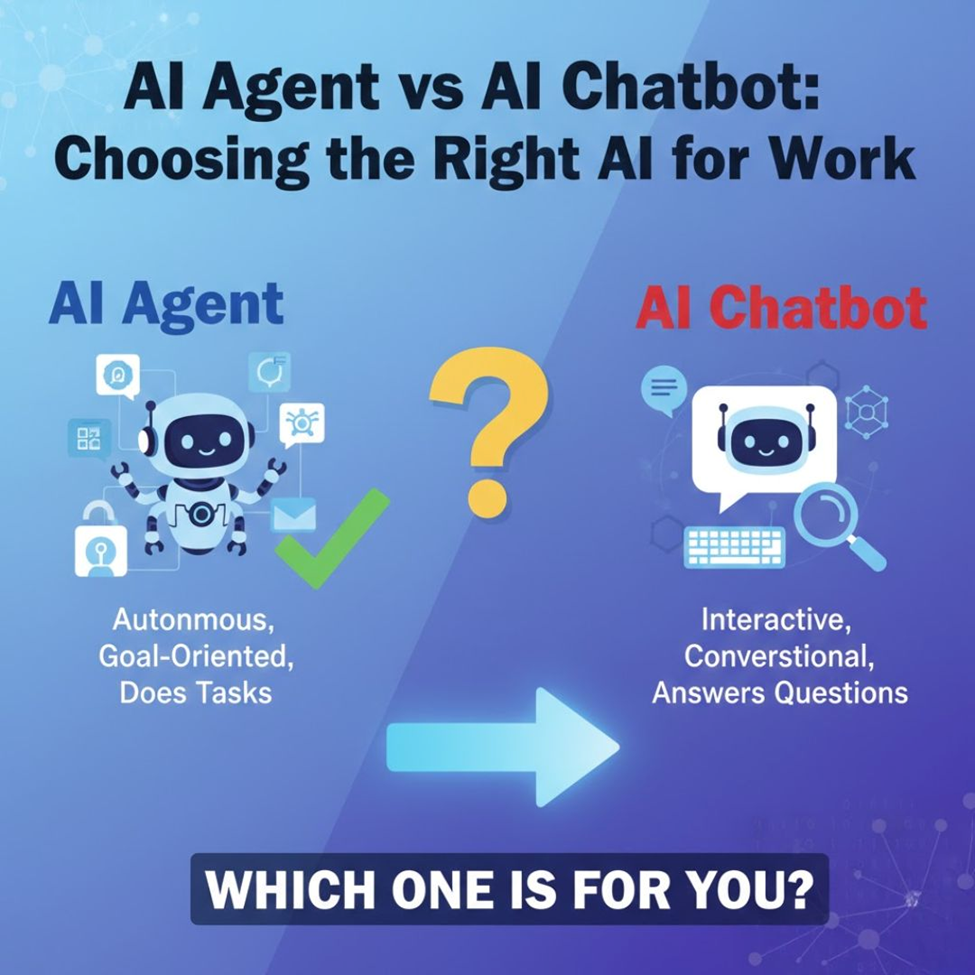

AI words get thrown around fast now. People say chatbot. Someone else says agent. Another person nods, even if they are not sure what either one really does. Over time, these terms start to blend. They sound similar. They even look similar on the screen. A chat box is a chat box, right?
That confusion causes real problems. AI Agent vs AI Chatbot is not a branding debate. It is a decision that shapes cost, outcomes, and team trust. Chatbots and agents solve different problems, even though they both “talk.” Pick the wrong one, and the tech gets blamed when the real issue is fit. This article breaks down the differences, overlaps, and real-world use cases so teams can choose clearly and avoid expensive detours.
What Is an AI Chatbot?
An AI chatbot is built around conversation. Its main job is to answer questions, guide users, and respond clearly. Think of it as a very patient team member who never gets tired of repeating the same answer.
A chatbot waits for input. Someone asks a question. It replies. That loop is its strength. It does not try to “run” your business. It helps people find what they need faster.
Where It Works Best
Most conversational AI chatbot systems shine when information is already known and structured. Policies. Product details. Pricing. Steps. Instructions.
Common strengths include:
- Website support and customer help
- FAQs and instant knowledge access
- Lead capture and early qualification
- Reducing ticket volume for human teams
Because of this, many companies begin with an AI Chatbot Builder. It lets teams launch quickly, test value, and improve answers without deep technical work. Tools like GetMyAI are often used at this stage to centralize knowledge and deploy chatbots across websites or internal tools.
Chatbots work best when the goal is clarity, speed, and consistency.
What Is an AI Agent?
An AI agent starts where chatbots stop. Conversation is still part of the interface, but it is not the goal. The goal is execution. An agent is built to move work forward, not just explain it. It connects decisions with actions, often across systems, and operates within defined rules to complete real tasks.
How It Goes Beyond Conversation
AI agents are designed for situations when answers alone are not enough. They move from “what should be done” to actually doing it. This shift changes how teams design workflows, manage risk, and think about automation inside the business.
Task-Oriented Intelligence
An AI agent is built to act. It can follow workflows, trigger systems, and complete multi-step tasks. Instead of explaining how to reset a password, it may reset it. Instead of listing onboarding steps, it can start them. This is the core of an autonomous AI agent.
Decision Context and Control
Agents work with goals, conditions, and logic. They evaluate context, check constraints, and choose next steps based on predefined rules. Some are tightly controlled. Others allow limited autonomy. This flexibility is powerful, but it demands careful planning to avoid errors or unintended actions.
Process Execution, Not Dialogue
AI agents are not advanced chatbots. They are made to complete tasks, not to chat smoothly. An AI-powered virtual agent is successful when work gets done correctly, not when replies feel friendly. Mixing these roles often causes bad design and unhappy users.
AI Agent vs AI Chatbot: Benefit-Wise Comparison
Before comparing features, it helps to step back and look at outcomes. This comparison is not about which technology is smarter. It shows how each system creates value in different ways, depending on business maturity, risk tolerance, and the kind of work teams expect the AI to handle day to day.
| Benefit Area | AI Chatbot | AI Agent |
| Primary Role | Conversation & answers | Task execution & automation |
| User Interaction | Reactive | Proactive + reactive |
| Complexity | Low to medium | Medium to high |
| Control & Predictability | High | Depends on design |
| Best Fit | Support, FAQs, lead capture | Workflows, operations, orchestration |
Most businesses do not choose one forever. They evolve. Early-stage teams often need fast answers and lower effort. Mature teams want systems that act. Understanding AI agents vs chatbots helps leaders match tools to readiness, not hype.
Industry-Wise Use Cases: Who Uses What and Why?
Different industries face different pressures. That shapes the choice more than trends ever will.
E-commerce & SaaS
Support volume is high. Questions repeat. Customers want instant clarity.
Here, chatbots handle product questions, order status, pricing, and onboarding. Behind the scenes, agents may update records, sync tools, or trigger workflows. This is a classic chatbot vs AI assistant split. One talks. One acts.
Healthcare, Finance, Legal
Accuracy matters more than speed. Risk is real.
Chatbots are used for controlled access to information. Hours. Eligibility. Process explanations. Agents often stay internal, helping staff with workflows while respecting compliance boundaries. An enterprise AI agent platform is usually required here, not a lightweight tool.
HR & Internal Teams
Employees ask the same questions again and again. Policies. Leave. Benefits.
Chatbots answer these instantly. Agents step in for onboarding, system access, or document creation. This combination supports a real AI chatbot for business use cases without over-automation.
Manufacturing & Logistics
Operations are complex. Delays are expensive. Small errors ripple fast.
Chatbots are used on the front line to answer questions about order status, inventory availability, delivery timelines, or standard operating steps. They reduce calls and interruptions on the shop floor. Agents work behind the scenes, updating inventory systems, flagging exceptions, or coordinating handoffs between tools. In this space, agents support execution, while chatbots protect focus.
Education & Training
The audience is large. Questions repeat. Resources are limited.
Chatbots help students, parents, or employees find schedules, course details, policies, and learning materials quickly. They act as always-on guides. Agents are used more selectively, often internally, to enroll users, assign training modules, or track completion across systems. The balance keeps support simple while automation stays controlled.
The key point is simple. The industry needs to decide on the tool. Not the trend.
How Businesses Decide Between an AI Agent and a Chatbot
Good decisions start with honest questions, not feature lists. Teams need to understand their real problems before evaluating tools. Asking what the issue today is, where time is lost, and what must actually change leads to better choices rather than comparing dashboards, integrations, or capabilities, which sounds impressive.
- First, look at volume versus complexity. If you have many simple questions, chatbots win. If fewer tasks require multiple steps, agents may help.
- Next, ask whether action is required. If users only need information, a chatbot is enough. If systems must change, agents enter the picture.
- Risk and control matter too. Chatbots are predictable. Agents require trust and guardrails. Budget and speed also play a role. Chatbots deploy faster. Agents take longer to get right.
Many teams start small and grow. They launch chatbots, learn user behavior, then expand into agents. Knowing the difference between an AI agent and a chatbot early prevents rework, confusion, and sunk costs.
It’s Not a Competition, It’s a Capability Choice
AI chatbots and AI agents are not rivals. They sit at different layers of automation and serve different business needs. One focuses on conversation, clarity, and access to information. The other focuses on execution, follow-through, and operational progress. The smartest teams do not ask which is better in general. They ask which capability fits the problem, the risk, and the stage of the business. With clear goals, the AI Agent or AI Chatbot decision becomes practical, grounded, and far more effective.
“For more detailed information and to learn everything you need to know, please visit Biz Well.”
