
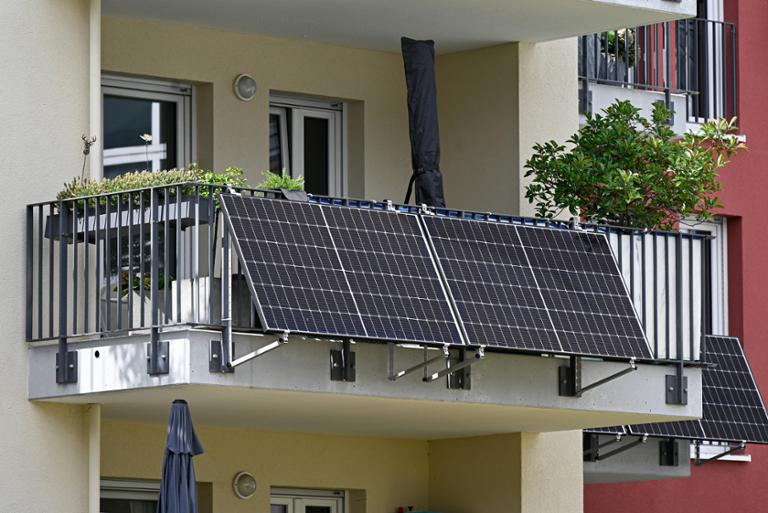

For a long time, rooftop solar power in the UK seemed to be an exclusive privilege for suburban homeowners. If you rent a property or live in a high-rise apartment in London or other major cities, installing a bulky solar panel array on the roof is virtually impossible. Property restrictions, complex planning permissions, expensive scaffolding costs, and landlord disapproval have consistently shattered the green energy dreams of urban residents.
However, as UK electricity prices continue to fluctuate at high levels, urban dwellers are welcoming an energy revolution of their own. The emergence of plug and play balcony solar systems has broken down the barriers of traditional photovoltaics, allowing apartment tenants to directly cut their electricity bills using their balconies, terraces, or windowsills.
The Electricity Bill Pain Points of Urban Apartments
Renting a flat or living in a major city like London often means enduring high tiered electricity rates while having absolutely no control over the building’s infrastructure. Traditional full-scale photovoltaic systems require permanent alterations, drilling, wiring, and grid modifications. For tenants, these assets cannot be taken away when the lease expires, making large upfront investments impractical.
Furthermore, due to the lack of suitable home micro-energy storage equipment, ordinary portable solar panels are highly inefficient. When the sun is shining brightly during the day and residents are out at work, the generated electricity often goes to waste. Conversely, during the peak evening hours when people return home, they are forced to buy expensive electricity from the grid. To truly solve this pain point, urban households need a lightweight system that requires no professional electricians, no structural damage to the property, and combines both energy storage and intelligent dispatch capabilities.
The Total Game Changer: Plug and Play Technology
The so-called “plug and play” technology means that the equipment does not require complex rewiring. Users simply plug the AC power plug of the micro-storage system directly into an existing standard household wall socket to connect it to the home grid.
This model completely eliminates the worries of urban renters. The entire process does not damage any walls, meaning it will not violate rental agreements. Most importantly, when the lease ends and it is time to move, you can simply unplug the device, pack it back into its box, and easily take it to your next home.
In this technical field, the Conow Lyra 2500 AC demonstrates exceptional adaptability. It completely abandons the tedious installation processes of traditional energy storage devices, eliminating the need for complex electrician operations. The entire process from unboxing to smart system configuration is remarkably straightforward for the user, fully maximizing the utility of urban balcony spaces.
Smart Dispatch and Electricity Price Arbitrage
Many people worry about the impact of unpredictable British weather when using balcony solar in the UK. In reality, relying on smart home energy management systems, modern balcony storage devices have achieved a high level of autonomous scheduling.
The Conow Lyra 2500 AC features smart grid interaction capabilities. Under the UK’s complex dynamic and time-of-use tariff mechanisms, even on gloomy winter days with insufficient sunlight, the system can slash expenses by automatically executing “electricity price arbitrage”. It automatically reads real-time electricity price data, charging and absorbing cheap electricity from the grid during the lowest valley price periods late at night. Then, during the peak evening hours when electricity is most expensive, it seamlessly switches to discharge mode to power essential household appliances like refrigerators, routers, televisions, and computers.
If solar panels are connected to the outside of the balcony, the system prioritizes storing the free photovoltaic electricity generated during the day into the battery instead of letting it flow back into the grid. This intelligent regulation mode requires no changes to the user’s daily routine while automatically shaving down electricity bills in the background.
Spatial Aesthetics Tailored for Modern Apartments
For space-constrained urban apartments, traditional industrial-style large batteries have nowhere to go. This demands that micro-energy storage equipment make breakthroughs in both size and aesthetics.
The machine base dimensions of this device are just 260 mm by 440 mm, with a height of 252 mm, taking up a footprint nearly identical to a standard sheet of A4 paper. This ultra-compact volume means it can easily blend into various corners of an apartment, whether it is a living room dead zone, an entryway hallway, or a balcony shelf. At the same time, it supports IP65-level dust and water resistance, allowing it to withstand the rainy and humid British climate even when placed on a semi-open, outdoor balcony.
Core Parameters and Power Delivery Capabilities
Despite its compact size, the internal hardware configuration is robust enough to handle the daily baseline needs of urban households. According to official factual data, the core technical specifications of the Conow Lyra 2500 AC are as follows:
- Battery Capacity: 2,560 Wh (utilizing A+ grade LiFePO4 batteries, supporting parallel expansion up to 5,120 Wh)
- Off-Grid Output Power: Rated at 1,500 W (up to 2,400 W in parallel mode)
- Cycle Life: Capable of over 6,000 cycles under a 25°C environment
- Device Dimensions: 260 mm × 440 mm × 252 mm
- Protection Rating: IP65
- Warranty Period: 10-year official warranty
- Device Weight: 27.7 kg
With a 1,500 W output capability, it can easily support the daily baseline electrical load of a typical apartment. Appliances that run around the clock, such as refrigerators, internet routers, and smart home hubs, can be continuously powered by it. At the same time, the dual independent AC output interface features microsecond-level seamless power switching, allowing it to act directly as a backup power source to protect critical electronic devices during sudden power outages.
Return on Investment (ROI) and Financial Payback
For any green technology product, consumers ultimately care most about the actual financial return. Traditional rooftop photovoltaics often take 8 to 12 years to break even, whereas balcony plug and play storage completely shatters this lengthy cycle.
By eliminating expensive scaffolding rental fees, structural safety assessment fees, and premium electrician labor costs, every single penny spent goes directly into the hardware equipment itself. The official price of the Conow Lyra 2500 AC stands at €649. Factoring in current average electricity price levels in the UK, using normal photovoltaic generation combined with dynamic tariff arbitrage allows the system to save families between €300 and €600 in electricity expenses annually.
This means that users typically need just 2 to 3 years to completely recoup the upfront hardware purchase cost. Backed by a 10-year official warranty and a cycle life exceeding 6,000 battery cycles, every single kilowatt-hour of electricity it produces over the remaining seven or eight years will represent pure household savings.
Conclusion
Urbanization and rental living conditions should not become roadblocks to achieving energy independence. By combining sophisticated AI energy management systems with compact plug and play hardware, UK apartment tenants finally have the power to actively control their electricity bills. If you want to find out exactly how much your balcony can save you in a year, you can use the free online calculator on the official Conow website to take your first step toward saying goodbye to sky-high energy bills.
