


There is a specific, exhilarating moment in a content creator’s career when the “hobby” officially transforms into a “business.” It usually happens when the first major brand deal lands in your inbox, or when your YouTube AdSense monthly payment starts to rival your rent.
However, that exhilaration is quickly followed by a daunting realization: you are now a business owner in the eyes of HMRC. Suddenly, you’re faced with a fork in the road that every UK creator must navigate: Should you operate as a Sole Trader or form a Limited Company?
Choosing the wrong structure can lead to thousands of pounds in unnecessary tax payments or, conversely, a mountain of administrative paperwork that kills your creativity. While many creators try to DIY this decision, the nuances of the creator economy fluctuating income, global payments, and “non-cash” gifts often mean that a specialized accountant for content creators is the most valuable partner you can have.
This guide isn’t just a list of definitions. It is a decision-making framework designed to help you choose the right path based on your actual income, your long-term goals, and your appetite for admin.
The Quick Answer (For Busy Creators)
If you are currently filming a video or prepping a brand pitch, here is the “too long; didn’t read” summary:
- Low Income (£0 – £30,000): Stay as a Sole Trader. The tax savings of a company won’t outweigh the costs of running one.
- Mid Income (£30,000 – £50,000): You are in the “Grey Area.” It depends on your other income sources and your plans for growth.
- High Income (£50,000+): A Limited Company is usually significantly more tax-efficient, allowing you to control how much you pay yourself and minimize National Insurance.
Sole Trader vs. Limited Company.What’s the Real Difference?
Before we look at the money, we have to look at the legal “DNA” of these two structures.
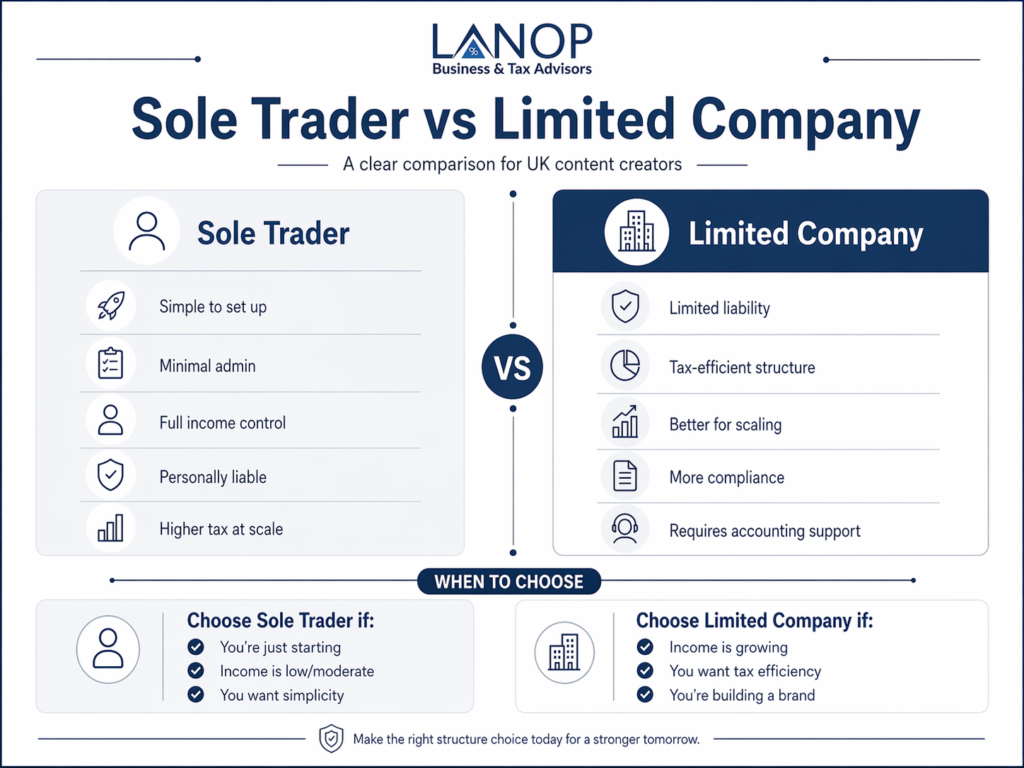
What Being a Sole Trader Actually Means?
As a sole trader, you and your business are legally the same thing. You are the business.
- Personal Liability: Because there is no legal “wall” between you and the business, you are personally responsible for any debts or legal issues. If you are sued for copyright or a brand deal goes south, your personal assets (like your car or home) could theoretically be at risk.
- Simplicity: Reporting is easy. You just file a Self-Assessment tax return once a year.
What Running a Limited Company Involves?
A limited company is a separate legal person. It has its own bank account, its own “birth certificate” (incorporation), and its own tax bill.
- Limited Liability: Generally, your personal assets are protected. The “limit” refers to your liability being limited to the money you’ve put into the company.
- Director Responsibilities: You aren’t just a creator anymore; you are a Director. This comes with legal duties to file accounts with Companies House and maintain strict records.
Key Structural Differences
| Factor | Sole Trader | Limited Company |
| Legal Status | You are the business | Separate legal entity |
| Liability | Unlimited personal liability | Limited to company assets |
| Tax Type | Income Tax & National Insurance | Corporation Tax & Dividend Tax |
| Privacy | High (records are private) | Low (records on Companies House) |
| Admin | Low (Annual Self-Assessment) | High (Annual Accounts, CT600, etc.) |
How UK Content Creators Actually Make Money?
Why does your industry matter for your tax structure? Because creators don’t get a “salary.” You have a fragmented revenue model that often includes:
- Brand Deals: Lump sums that arrive at irregular intervals.
- Platform Earnings: AdSense or Creator Funds (often paid in USD).
- Affiliate Marketing: Hundreds of small payments from various sources.
- Digital Products: Passive income from courses or presets.
This irregularity is the biggest argument for a Limited Company. If you are a sole trader and you have a “viral” month where you earn £20,000, you are taxed on that money immediately. In a Limited Company, you can keep that money in the business bank account and pay it out to yourself slowly over several months, keeping yourself in a lower tax bracket.
Tax Differences Explained (With Real Examples)
This is where the decision usually becomes clear. Let’s look at how math works in the real world.
How Sole Traders Pay Tax?
You pay Income Tax on your profits (Income minus Expenses).
- Personal Allowance: The first £12,570 is tax-free.
- Basic Rate: 20% on income up to £50,270.
- Higher Rate: 40% on everything above that.
- National Insurance (NI): You pay Class 4 NI on your profits, which can be a significant “hidden” tax.
How Limited Companies Pay Tax?
The company pays Corporation Tax (currently 19% to 25%) on its profits. To get the money to you personally, you usually take a small salary and the rest as Dividends.
- Dividends have lower tax rates than regular income.
- Crucially, you don’t pay National Insurance on dividends. This is where the big savings happen.
Real Income Scenarios (Annual Profit)
Example 1: The Rising Star (£25,000 Profit)
- Sole Trader: Tax/NI bill is roughly £3,200.
- Limited Company: After accounting fees and corporation tax, the saving is negligible. The extra admin isn’t worth it.
- Verdict: Stay Sole Trader.
Example 2: The Established Creator (£55,000 Profit)
- Sole Trader: You’ve hit the 40% tax bracket. Your bill is roughly £11,800.
- Limited Company: By taking a smart mix of salary and dividends, your total tax bill could be around £9,500.
- Verdict: You are saving over £2,000 a year. This is the tipping point.
Example 3: The Top Tier (£100,000 Profit)
- Sole Trader: Your tax/NI bill is roughly £30,000.
- Limited Company: Your bill could be closer to £23,000 depending on how much you leave in the company.
- Verdict: Saving £7,000 a year makes a Limited Company a “no-brainer.”
The Decision Table (Exactly What You Should Choose)
| Profit Level | Recommended Structure | Primary Reason |
| £0 – £30,000 | Sole Trader | Low admin, low cost, trading allowance. |
| £30,000 – £50,000 | Case-by-Case | Transition phase; depends on future growth. |
| £50,000 – £100,000 | Limited Company | Significant NI savings and tax flexibility. |
| £100,000+ | Limited Company | Essential for tax planning and asset protection. |
Hidden Costs Nobody Talks About
Before you rush to Companies House to register “MyChannel Ltd,” you need to account for the costs of being a company.
- Accounting Fees: A sole trader return is simple. A Limited Company requires statutory accounts and a Corporation Tax return. You will likely pay more for an accountant for a content creator to handle a company than a sole trader setup.
- Software: You’ll need a robust system like Xero or QuickBooks to track every penny (HMRC is much stricter with companies).
- Filing Fees: Small fees to Companies House every year to file your Confirmation Statement.
- The Break-Even Thinking: If the tax savings of a company are £1,000 but the extra accounting and software costs are £1,200, you are actually losing money by being “professional.”
When Should You Switch to a Limited Company?
Timing is everything. Moving too early is a headache; moving too late is a waste of money.
Signs You’re Ready:
- Consistent Growth: Your income isn’t just a “one-off” viral hit; it’s a steady upwards trend.
- Crossing the £50,270 Mark: This is where you hit the 40% tax bracket. Companies allow you to “park” money to avoid this.
- Hiring Help: If you’re hiring an editor or a VA, a company structure makes the employment process more robust.
Signs You Should Wait:
- Unstable Income: If you have £5,000 months followed by £200 months, the fixed costs of a company will hurt you.
- Side Hustle Stage: If you have a full-time job and the creator income is just “pocket money,” the complexity is usually too high.
Common Mistakes Content Creators Make
- Ignoring PR Gifts: HMRC treats that free £2,000 camera or the £5,000 “free” Maldives stay as taxable income. If you don’t report these, you could face massive fines, regardless of your structure.
- Waiting Until January 30th: Trying to find receipts for a trip you took 14 months ago is a nightmare.
- Assuming Limited Means Invisible: Your name and business address will be public on Companies House. If you value privacy, you need a registered office service.
- Not Registering for VAT: If your turnover (not profit) hits £90,000 in a rolling 12-month period, you must register for VAT. This applies to both Sole Traders and Limited Companies.
Special Scenarios Most Blogs Ignore
Side Hustle vs. Full-Time Creator
If you have a day job, your creator income is added “on top” of your salary. This often pushes you into the 40% bracket much sooner. In this case, a Limited Company is often better even at lower creator income levels because it allows you to defer taking the money until a year when your other income is lower.
International Payments
Receiving USD from YouTube or sponsorships from the US? You need to understand Withholding Tax (W-8BEN forms). A specialized accountant for content creators ensures you aren’t being taxed twice on the same dollar.
Do You Need Professional Help?
There is a reason why top-tier creators have accountants. As your income scales, the “cost of being wrong” increases.
A specialized accountant for content creators does more than just “file taxes.” They understand how to:
- Value your PR gifts so you don’t overpay tax.
- Navigate the “Reverse Charge” for VAT on digital services.
- Advise on when to move from Sole Trader to Limited Company to the exact month.
- Claim for specific creator expenses like “set dressing,” home studio proportions, and equipment.
Sole Trader vs. Limited Company (Final Verdict)
The “Better” structure is the one that fits your current reality.
- Stay a Sole Trader if you are still figuring things out, your income is under £30k, and you want to spend your time creating content, not filing forms.
- Go Limited if you are earning over £50k, you want to protect your personal assets, and you are ready to treat your “influence” as a high-growth business.
The most important thing you can do today is to start tracking. Whether you are a sole trader or a company director, clear data is the only way to make a confident decision.
FAQs(Frequently Asked Questions)
What is the main difference between a sole trader and a limited company?
As a sole trader, you and your business are legally the same entity simply to set up but you’re personally responsible for any debts. A limited company is a separate legal entity that protects your personal finances. Sole trader suits beginners, while a limited company is better as your income grows.
Which structure is more tax efficient for content creators?
A limited company becomes more tax efficient once your profits exceed around £30,000–£40,000 per year. You can pay yourself a small salary and take the rest as dividends, which are taxed at lower rates than regular income. As a sole trader, all profits are hit with Income Tax and National Insurance, which can be significantly more costly.
Is running a limited company more complicated than being a sole trader?
Yes, considerably. As a sole trader you simply file one Self Assessment return a year and keep basic records. A limited company requires registering at Companies House, filing annual accounts, running payroll, and submitting a Corporation Tax return; most creators hire an accountant to manage this, which adds to your costs.
Can I switch from sole trader to a limited company later?
Yes, and most successful creators do exactly that. Many start as sole traders while income is low, then incorporate once earnings reach a level where the tax savings outweigh the extra admin costs. The process is straightforward: register through Companies House, open a business bank account, and begin trading through the new company.
Does a limited company look more professional to brands?
Yes, in many cases it does. Larger brands and agencies often perceive limited companies as more credible and established, and some corporate clients actually require suppliers to be incorporated before signing contracts. That said, plenty of successful sole trader influencers land major brand deals, so it shouldn’t be your only reason for incorporating.
What are the key risks of each structure?
The biggest sole trader risk is unlimited personal liability any legal claim against you could affect your personal assets including savings and property. A limited company protects you through limited liability but comes with stricter obligations: missing filing deadlines triggers automatic fines, and misusing the structure could attract unwanted HMRC scrutiny.
Conclusion:
The decision between becoming a sole trader or forming a limited company is one of the most important choices a UK content creator will make. If you are just starting out with modest income, the simplicity of being a sole trader makes perfect sense. But as your brand and earnings grow, the tax efficiency and credibility of a limited company become harder to ignore.
The key is not to make this decision in isolation; your chosen structure affects everything from how you pay yourself to how brands perceive you. That’s where Lanop Business and Tax Advisors comes in. From choosing the right structure and company formation to tax planning and HMRC compliance, their specialist team ensures your business is set up to maximise your income and support your long-term growth.
With Lanop Business and Tax Advisors by your side, you can build your creator business on a foundation that is not just compliant but truly optimised for success.
