
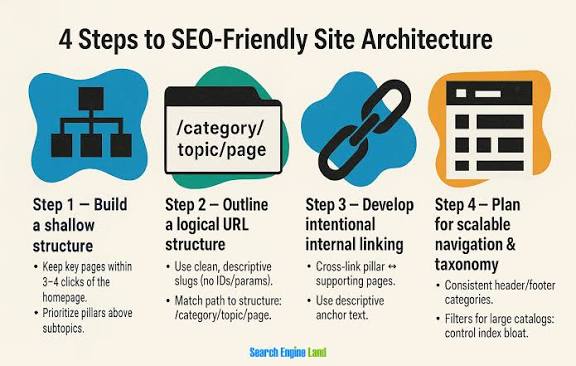

A well-structured website is one of the foundations of effective Search Engine Optimisation (SEO). While businesses often focus on content creation, keywords, link building, and technical enhancements, the underlying architecture of a website plays an equally important role. Good site architecture helps search engines understand content relationships, improves user navigation, and supports long-term scalability — all of which contribute to stronger Search Engine Optimization performance.
For businesses in Singapore working with an SEO Agency or digital marketing partner, understanding the impact of site structure can lead to better optimisation decisions and more sustainable organic growth. This article explores how site architecture influences SEO and the key principles businesses should consider when shaping their websites.
What Is Site Architecture?
Site architecture refers to the way a website’s pages are organised, interconnected, and presented to both users and search engines. It includes:
- Navigation menus
- URL structure
- Internal linking patterns
- Content hierarchy
- Page grouping and categorisation
A strong site architecture allows search engines like Google to crawl, index, and understand a website easily. When pages are organised logically, they become more accessible, more discoverable, and more likely to rank for relevant queries.
Why Site Architecture Matters for Search Engine Optimisation
1. Improved Crawlability and Indexing
Search engines depend on crawlers to discover and index content. A clear and structured site layout makes this process more efficient. If search engines struggle to crawl a site due to deep page levels, broken links, or confusing navigation, key pages may remain undiscovered or indexed incorrectly.
Shallow, well-connected site architecture ensures:
- Important pages are reached quickly
- Crawlers do not waste time on unnecessary paths
- Duplicate or orphan pages are minimised
This leads to better overall visibility in search results.
2. Clear Hierarchy Helps Google Understand Content
Google’s ranking systems rely on contextual understanding. A logical hierarchy — from broad categories to more detailed pages — helps search engines determine how content relates to each other, what pages are most important, and which topics a website specialises in.
For example, an SEO Agency may structure its content as:
- /services/seo/
- /services/seo/on-page/
- /services/seo/technical/
- /services/seo/content-strategy/
This structure signals content depth and relevance, supporting stronger Search Engine Optimisation across multiple topics.
3. Enhanced User Experience and Engagement
User experience is closely tied to SEO performance. When visitors can find content easily, they tend to stay longer, engage more, and interact with several pages. These behaviours support positive SEO signals such as:
- Lower bounce rates
- Higher time spent on site
- Increased page interactions
Clear menus, intuitive internal links, and meaningful category groupings increase navigability, which helps users and search engines simultaneously.
4. Better Internal Linking Opportunities
Internal links help distribute authority across a website, guiding users and search engines to key pages. Strong architecture enables:
- Topic clustering
- Related-article suggestions
- Efficient link equity flow
This results in a stronger SEO foundation, particularly for pillar pages that require high visibility.
5. Reduced Duplicate Content Issues
Poor site architecture often leads to duplicate content — when similar or identical pages appear across multiple URLs. This can confuse search engines and dilute ranking strength. Strategic structuring ensures each page serves a clear purpose and avoids unnecessary duplication.
Key Elements of Effective Site Architecture
1. Logical and Hierarchical Structure
A website should follow a top-down hierarchy that groups related content together. Typical three-level structures include:
- Home
- Category
- Subcategory
- Individual page
Keeping structures simple ensures navigability and crawl efficiency.
2. Clean and Consistent URL Structure
URLs should be descriptive, readable, and consistent. For example:
Good:
example.com/seo-services/technical-seo
Less Effective:
example.com/cat?id=567&service=tech
Clean URLs help search engines understand content without ambiguity.
3. Strong Navigation System
Navigation menus should reflect the site’s overall hierarchy. Clear menus help users find key pages while giving search engines a reference point for page importance.
Common navigation best practices include:
- Avoiding overly complex dropdowns
- Prioritising important categories
- Including a footer menu for secondary links
4. Strategic Internal Linking
A well-linked site helps distribute authority and guides users logically. Internal linking strategies include:
- Linking from category pages to subpages
- Linking between related articles
- Using breadcrumbs for easy navigation
Breadcrumbs also help search engines understand structure by showing the hierarchy of content.
5. Fast Page Loading and Technical Cleanliness
Technical aspects — such as page speed, mobile responsiveness, and secure protocols — support good architecture. They ensure that both users and crawlers navigate the website without obstacles.
Common Site Architecture Problems That Harm SEO
1. Deep or Buried Pages
If important content is several clicks away from the homepage, it becomes harder to crawl and less likely to rank well.
2. Too Many Unrelated Categories
Overly broad or unrelated categories confuse search engines about a site’s topical focus.
3. No Clear Internal Linking Pattern
Random or inconsistent internal links make it difficult for Google to understand the relevance of pages.
4. Orphan Pages
Pages with no internal links pointing to them are effectively invisible to search engines.
5. Duplicate and Auto-Generated URLs
These commonly occur in poorly configured e-commerce or filter systems, leading to unnecessary indexing issues.
How Singapore Businesses Benefit from Better Site Architecture
Businesses in Singapore face strong competition in digital markets. Whether offering services locally or globally, optimised site architecture supports:
- Faster indexing in regional searches
- Stronger topical authority for competitive keywords
- Better performance in mobile-first environments
- Scalable expansion across markets and services
For companies working with an SEO Agency, technical site structure is a core foundational step before deeper optimisation begins.
Conclusion
Site architecture is a critical component of effective Search Engine Optimisation. When a website is structured logically, it becomes easier for users to navigate and for search engines to index, interpret, and rank content. From improved crawlability to better internal linking and cleaner URL structures, strong site architecture enhances overall SEO performance and sets the stage for long-term digital growth.
For businesses in Singapore and worldwide, prioritising site architecture is essential, whether they are building a new website or refining an existing one. A well-organised structure is not just good for SEO — it is central to creating a sustainable online presence.
