
Smart mattress privacy comes down to four answers: what is collected, where it lives, what it is used for, and whether you can switch it off or erase it. This comparison puts the two most-discussed designs on the same table: the DeRUCCI T11, with its sensing embedded in a mattress you buy once, and the Eight Sleep Pod, a biometric cover shipped as hardware plus a recurring plan. The ground rules: every claim below comes from the companies’ published materials, read side by side.
Two Designs, Two Data Chains
Whatever the brand, sleep tracking data moves through the same four stages, and the stage that matters most is storage — the cloud account where policy takes over from engineering. The two designs differ at the edges: where the sensors sit, whether a hub sits under the bed, and what each system does with the stream once it lands.
Sleep tracking data moves in four layers — built-in sensors, Bluetooth and Wi-Fi transport, a cloud account, and the reports the system gives back. On the T11 side, the sensing sits inside the mattress surface: it registers heart rate, respiration, sleep-stage transitions and body movement, with nothing strapped to a wrist. The T11 PRO’s SleepCare layer runs cardiopulmonary coupling (CPC) analysis developed with Harvard collaborators, per the company’s published materials. The bed pairs over Bluetooth and 2.4GHz Wi-Fi — 5GHz networks are not supported.
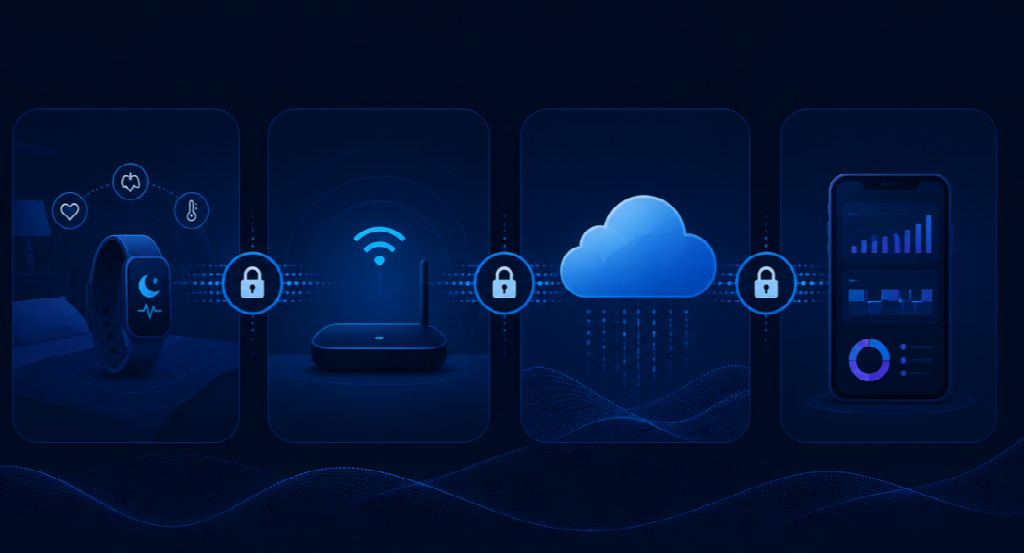
This image is AI-generated for reference only, not an actual product photo.
On the Pod side, per Eight Sleep’s published product page, the biometric sensors are embedded in the cover itself — the layer that wraps the mattress you already own — and a separate hub unit fits under most bed frames, delivering the adjustments through the night. The system tracks sleep stages, heart rate and snoring, and syncs to Apple Health and Health Connect. Same four layers, different placement: the sensing travels with a removable layer, and the processing lives in a box under the bed.
For background reading, published accuracy studies of consumer sleep technologies map what today’s home sensing does well: heart rate and breathing readings that hold up across devices.
The Business Model Behind the Data
Two bills follow two philosophies. The cover route prices as hardware plus a mandatory annual plan; the embedded route closes the data bill at purchase. At the listed rate, five years of the plan compounds to roughly four figures on top of the hardware — the number that reshapes the privacy question, because data features you pay for yearly are data features a business must keep you using.
Eight Sleep’s numbers, per its published pricing as of this writing: the Pod hardware starts at $2,799, and the cover’s functions tie to a mandatory plan listed at $199 per year when the rate was last verified. Re-check both figures on the brand’s own page before any decision; pricing moves. At the listed rate, five years of the plan adds roughly $995 on top of the hardware. The search phrase “eight sleep alternative” existing at all is a data point: some buyers hunt a route with no annual fee.
DeRUCCI’s side of the ledger, per the company’s published materials: no monthly fee for the data service after the hardware purchase, and nothing to wear — the sensing is in the bed surface, bought once with the mattress. The wearable camp — rings and bands from the major wearable makers, in the category research compiled here — carries its own cost: the sensor travels with you, and it is one more device to charge and remember.
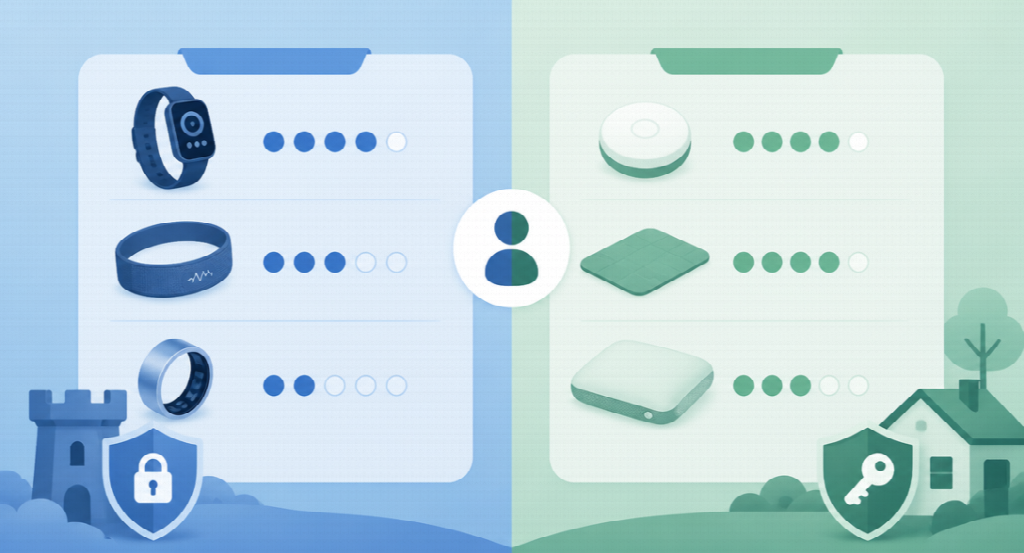
This image is AI-generated for reference only, not an actual product photo.
The business model shapes the incentives: a design whose data features are bought once answers to the buyer; one that renews yearly answers to retention as well. The standard worth applying to any number on a sleep report is measurement that leads to a decision — a number that changes what you do next.
The Four Questions, Answered on Each Side
Four questions cut through any privacy policy: what is collected, where the records live, who can read them, what they are used for, and whether collection can be switched off or erased. Put to both designs, three answers separate on checkable facts — sensor form, wearability, and the subscription — while the policy-depth answer requires the current documents from both makers.
Privacy questions before buying: what is collected, where it lives, who can see it, what it is used for, and whether you can switch it off or erase it. Asked of each side:
– What is collected. The T11 reads heart rate, respiration, sleep-stage transitions and body movement from inside the mattress, per its documentation; the Pod reads sleep stages, heart rate and snoring from its cover, per its product page. Both streams land as nightly reports.
– Where records live. A cloud account tied to the buyer, on both sides. This is where policy replaces engineering, and where the fine print — not the marketing page — governs.
– Who can read them. DeRUCCI’s stated policy restricts records to the account holder’s own view. For the Pod, the current policy text on the maker’s site governs; read it in the market you are buying in before money moves.
– What they are used for. On the T11, the stream drives the personal sleep program and, on higher tiers, the automatic firmness adjustments through the night. On the Pod, per its product page, the stream drives the cover’s temperature responses and the app’s insights.
– Whether you can switch it off. DeRUCCI’s stated policy puts in-app switches for stopping collection and deleting history, and the demo-unit test below shows how to verify that with your own hands. On the Pod side, ask the same question of the current policy text — and note what functions the plan gates before you answer it.
On business model, sensor form and wearability — the three differences you can check today — the designs part ways on the record. For policy depth, the current documents from each maker, in your market, are the governing text.
How to Verify Either Brand’s Privacy Claims in Person
The strongest privacy language still deserves a first-hand check, on either side of this comparison. Confirm the claims against the current policy text for your market before money moves; three showroom checks turn the promise into something you have witnessed yourself.
On encryption, DeRUCCI’s stated policy describes bank-grade protection for account data; the current document in your market is the version that governs. The same habit serves any product page: when the text names its mechanism, the claim is on record, and the three checks below put it in your hands.
One behavior worth knowing on each side. On the T11’s higher tiers, the sleep reports, the newest adaptive algorithms and the vital-sign tracking run on an active connection; offline, automatic adjustment keeps working — the bed keeps re-tuning support through the night. On the Pod side, the same question lands on the plan: which functions survive without the subscription, and which stop — ask it before purchase, in writing.
Hence three steps worth running on any floor model, either brand. Start with the policy document itself: the version that applies to your market, finished before talk turns to firmness. Ask to trigger “stop collection” plus “delete history” with your own hands on the demo unit — a path buried four menus deep, or one that errors out on a demo account, is a warning sign worth heeding. Ask the staff to name which functions survive with no network. For the institutional backdrop, the NIST edge systems data privacy framework shows how researchers structure privacy analysis for always-on edge devices.
Availability and the Long Game
Availability frames everything above. The T11 SE AI mattress is now available at the DeRUCCI New York store. For other markets, get availability confirmed in writing before planning a room around a specific model. Servicing runs 10 years from delivery — labor covered, parts and logistics billed.
On the ground, the Pod route ships direct per its product page; for any other market, get availability in writing before planning a room around a specific model. On the calendar, DeRUCCI’s published servicing framework keeps the bed serviceable for 10 years from the delivery date — labor covered, parts and logistics billed. That horizon matters on both sides of this comparison: a decade is the span over which policy text gets amended, subscription rates move, companies restructure and platforms migrate. The exit-right questions above are worth repeating once a year, and the long-run bill — one that closed at purchase, or one that renews every year — is part of the same decision.
DeRUCCI T11 vs Eight Sleep Pod: FAQ
Is DeRUCCI or Eight Sleep better for sleep-data privacy?
On the three differences the published record supports: the T11’s sensing is embedded in the mattress with no wearable and no recurring data fee after purchase, per DeRUCCI’s published materials; the Pod’s sensing lives in a cover, powered by a hub under the bed, with functions tied to a plan listed at $199 per year when last verified, per its published pricing. On policy depth — retention, sharing, deletion terms — the current documents from both makers govern: read them in your market before deciding, and run the stop-and-delete test on a floor model.
Will the bed still work if I stop data collection?
On the T11, yes: offline, automatic adjustment keeps working — the bed keeps reading the body’s shifts and re-tuning support through the night. Sleep reports, the newest adaptive algorithms and vital-sign tracking run on an active connection; a 2.4GHz phone hotspot covers that whenever needed. On any cover-route system, ask the mirror question before buying: which functions the plan gates, and which survive without it.
How do I verify a privacy promise before buying?
Three moves in the store, for either brand: read the policy document for your market before the sales talk deepens; run “stop collection” and “delete history” yourself on a floor model, watching for buried menus or demo-account errors; and have the staff list the features that survive without network. Where encryption is described, look for the named mechanism in the current document.
Privacy is one axis of a wider decision. For the full question set, which data and privacy questions to ask before buying a sleep-tracking mattress, collects them in one place, and the smart mattress buying decision guide covers the whole checklist, from support architecture to long-run cost. To put the four questions to a physical unit, the DeRUCCI store locator lists addresses for running the exit-right steps in person.
