
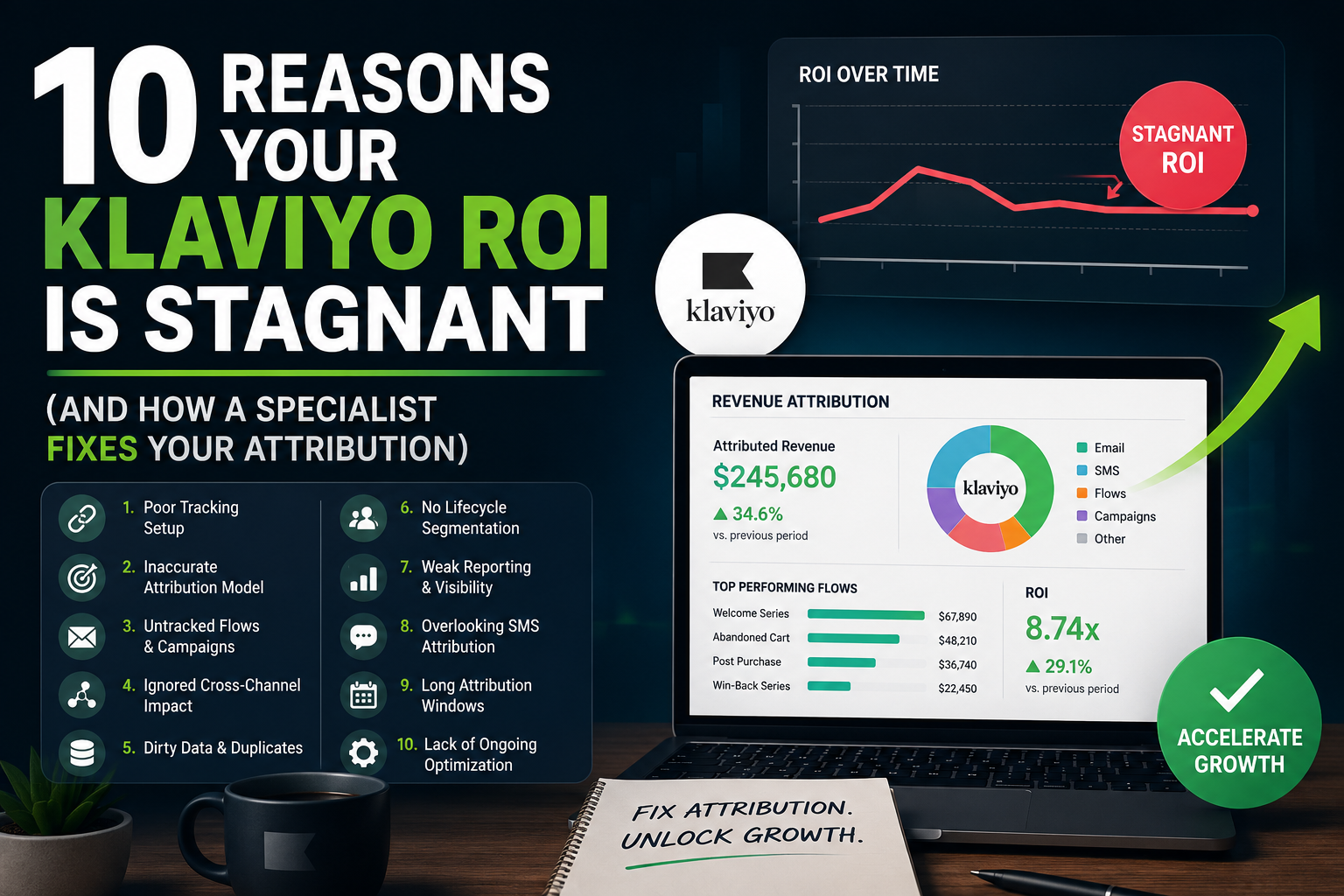

You’ve seen the case studies. You’ve heard the stories of e-commerce brands generating 40% of their total revenue through email alone. You’ve invested in Klaviyo, but for some reason, your dashboard looks flat.
The revenue is trickling in, but it isn’t the flood you were promised. For many Australian SMEs, the problem isn’t the platform; it’s a combination of invisible technical hurdles and skewed data. When your ROI is stagnant, it usually means your attribution is broken or your strategy is stuck in “set and forget” mode.
What You’ll Learn in This Article
• How to identify the “silent killers” of email deliverability and tracking.
• The difference between “Klaviyo revenue” and actual business profit.
• How a Klaviyo partner can optimise your flows for long-term customer lifetime value.
1. Deliverability Is the Silent ROI Killer
If your emails aren’t landing in the inbox, they don’t exist. Klaviyo won’t show you when you’re hitting the Promotions tab or the spam folder; it will show instead as lower engagement.
Deliverability issues often stem from poor list hygiene or outdated sender authentication (SPF, DKIM, DMARC). When your emails are “sent” but not “seen,” your ROI hits a ceiling that no amount of amazing copywriting can break.
2. Broken Tracking
Since the introduction of major privacy updates, onsite tracking has become notoriously “leaky.” If your Klaviyo tracking script isn’t firing correctly across every page of your site, you’re missing vital data.
You need to ensure that your key events eg “Viewed Product” and “Add to Cart” events are capturing every possible lead. Without this, your most profitable flows never trigger, potentially leaving thousands of dollars on the table. If you’re not tech savvy a Klaviyo expert can help set this up.
3. Flows and Campaigns are Cannibalising Each Other
Are you blasting your entire list with a Friday sale while your new subscribers are only halfway through their Welcome Series? This is a classic mistake that leads to “inbox fatigue.”
When campaigns and flows compete, you aren’t necessarily making more money; you’re just annoying your best prospects. Setting up frequency caps and smart sending filters ensures you aren’t over-communicating. Klaviyo makes this easy.
4. Your Attribution Window is a “Blunt Instrument”
Klaviyo’s default setting often uses a 5-day email and 24-hour SMS attribution window. For some brands, this is too short, missing the slow-burn conversions. For others, it’s too long, taking credit for sales that would have happened anyway.
A Klaviyo expert will help you analyse your specific time-to-purchase. By adjusting these windows to match your actual customer behavior, you get a realistic view of which emails are truly driving profit.
5. You’re Only Using the “Hero” Flows
Most SMEs set up a Welcome Flow and an Abandoned Cart flow and stop there. If that’s you, you’re ignoring the most profitable part of the customer journey: the post-purchase experience.
A Klaviyo partner looks at the gaps. Are you running “Back in Stock” notifications? Are you triggering “Win-back” sequences for customers who haven’t bought in 90 days? These “unseen” automations often hold the highest ROI.
6. SMS and Email Overlap
If a customer gets an email AND a text message for the same offer within five minutes, you aren’t “omnichannel”: you’re just expensive. SMS is a high-intent, high-cost channel.
Using it effectively means only sending texts to those who haven’t opened the email, or for time-sensitive alerts like “Cart Expiring in 2 Hours.” Mismanaged SMS strategy is one of the fastest ways to tank your overall marketing ROI.
7. The “Set and Forget” Trap
The biggest reason ROI stagnates is a lack of testing. What worked in the 2024 holiday season might not work today.
What should you be testing?
• Subject lines: To improve open rates.
• Send times: Finding when your specific audience is most likely to buy.
• Offer types: Does “Free Shipping” perform better than “10% Off”?
Fix Your Foundation to Scale Your Revenue
If your Klaviyo performance has hit a plateau, it’s rarely because your products aren’t good enough. It’s usually because the technical foundation: the tracking, the attribution, and the segmentation: has become outdated.
Don’t let another month of missed revenue pass by. If you’re unsure where your leaks are, a full account audit is the first step toward turning those stagnant numbers into a growth engine.
