
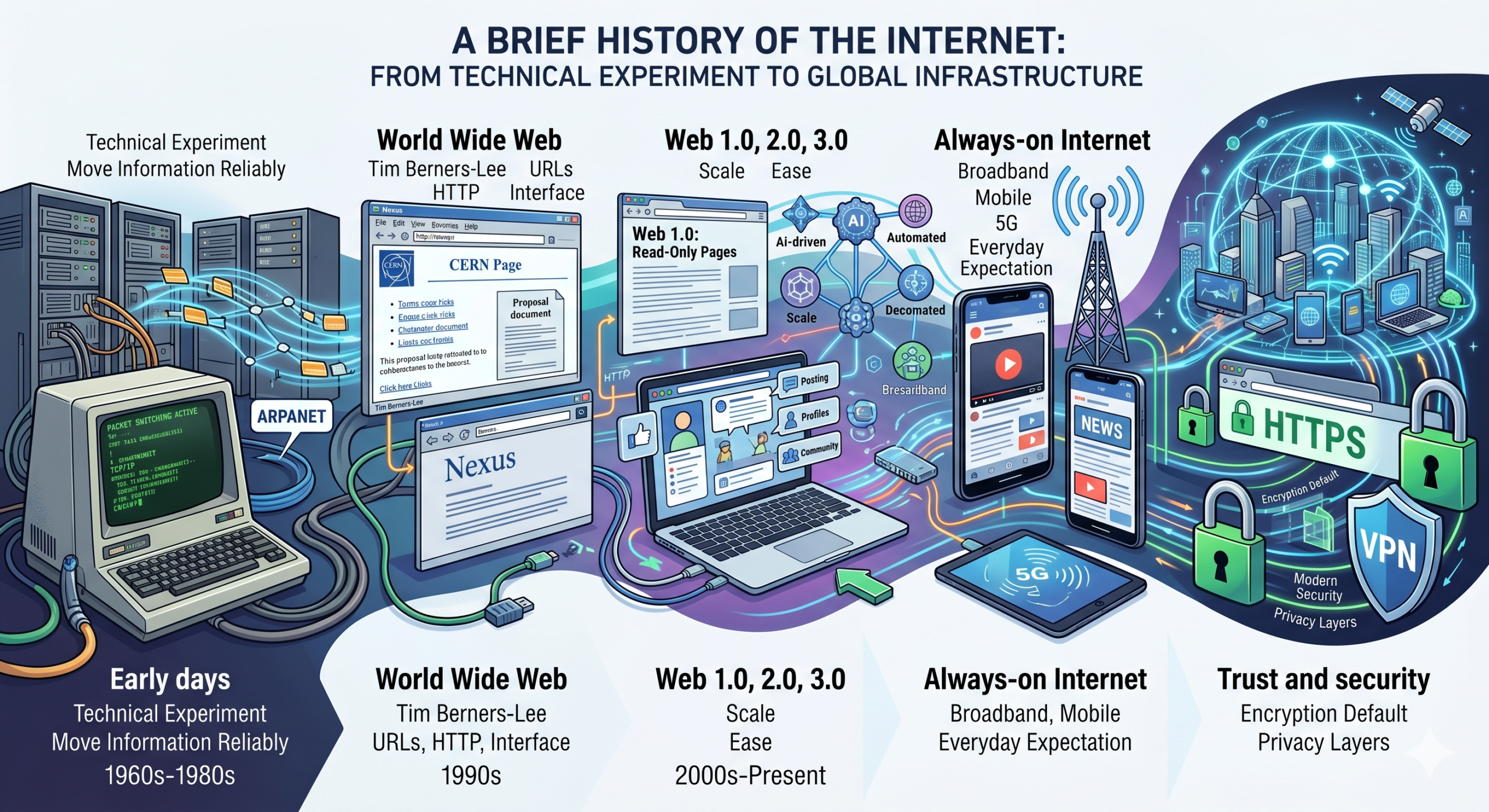

The Internet did not begin as something people used to watch videos, order trainers, or argue about football. It started as a serious technical experiment: how to move information reliably, even when connections were unreliable. From there, it grew into the background system modern life runs on: work, entertainment, shopping, news, politics, and relationships.
The biggest changes have not only been about speed. They have been about scale (from a small research network to billions of users), ease (from typing commands to tapping icons), and trust (from “assume things are fine” to “encrypt everything”).
The early days: the plumbing comes first
Before the web existed, researchers developed a smarter way to send data: break messages into small chunks (“packets”), send them across different routes, then rebuild them at the other end. That approach was more resilient than older systems that depended on one fixed connection.
Then came the real glue: TCP/IP, the shared “language” that allowed different networks to talk to each other. That is the Internet in its purest form: not websites, just connected networks.
The web: the front door to the Internet
The Internet became useful to ordinary people when the World Wide Web arrived. At CERN, Tim Berners-Lee proposed a way to link documents using URLs and HTTP, accessed through a browser. In plain terms: the Internet provided the pipes; the web provided the interface most people could actually use.
Web 1.0, 2.0, 3.0: from pages to platforms to systems
Early web culture (often called Web 1.0) was mostly read-only: static pages, simple sites, minimal interaction. Then Web 2.0 turned the Internet into a social space: posting, commenting, sharing, and building communities. The web stopped being a library and started acting like a city: busy, noisy, and shaped by the people inside it.
More recently, “Web 3.0” has become shorthand for a mix of decentralisation, smarter services, and AI-driven experiences. Some of it is genuinely new, some of it is marketing, but the direction is clear: the Internet is becoming more automated, more personalised, and less tied to single websites people deliberately “visit.”
Always-on Internet: broadband, mobile, and 5G
The move from dial-up to broadband made the Internet continuous. Fibre made streaming normal. Smartphones made being online portable, and personal. Today, connectivity is not a nice extra; it is an expectation. When it breaks, it does not feel like “a website is down.” It feels like part of daily life stops working.
Trust and security: why everything became HTTPS
As the Internet became essential, it also became a target: scams, interception, data theft, fraud. That is why encryption became the default. Modern web security (like TLS) makes everyday browsing safer and faster than older systems ever could. Tools like automatic certificates pushed secure connections from “only big companies bother” to “almost everyone should.”
For everyday users, it is also why extra privacy layers can matter on public Wi-Fi, whether that is being more careful about networks, or using tools like a VPN Chrome or whichever browser you’re using, when needed.
Where things are now
The Internet’s story is basically expansion: research project to mass utility; fixed to mobile; open-by-default to encrypted-by-default. In 2026, it is less a “place people go” and more the invisible infrastructure everything depends on, and what comes next will be shaped as much by security and standards as by speed.
