
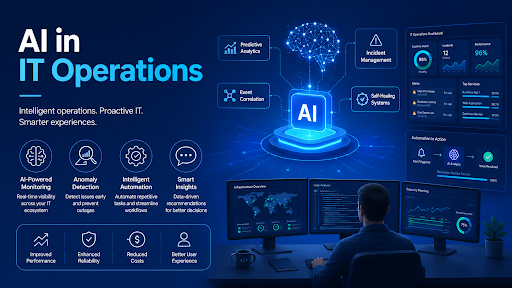

Modern enterprises operate in an increasingly complex digital landscape where technology is central to every business function. From managing infrastructure and safeguarding critical data to supporting employees and delivering seamless customer experiences, IT teams are expected to maintain high performance while driving innovation. Traditional approaches to IT management, however, often struggle to keep pace with growing data volumes, distributed environments, and evolving cybersecurity threats.
This is where AI in Information Technology (IT) is creating a significant impact. By combining machine learning, intelligent automation, predictive analytics, and natural language processing, artificial intelligence enables organizations to optimize operations, improve decision-making, and proactively manage technology ecosystems. Rather than replacing IT professionals, AI empowers them to focus on strategic initiatives by automating repetitive tasks and delivering actionable insights.
As businesses continue their digital transformation journeys, artificial intelligence is becoming a fundamental component of modern IT strategies that improve operational resilience, business agility, and long-term competitiveness.
Understanding the Role of Artificial Intelligence in IT
Artificial intelligence has evolved from being an emerging technology to a practical business capability. Today, organizations use AI to analyze vast amounts of operational data, identify patterns, predict potential issues, automate workflows, and improve service quality across enterprise environments.
Unlike conventional automation, AI continuously learns from historical and real-time data, enabling systems to make informed recommendations and respond intelligently to changing conditions. This capability allows IT departments to shift from reactive maintenance to proactive management while improving efficiency across infrastructure, applications, cloud environments, and cybersecurity operations.
Core Technologies Driving Enterprise AI
Several advanced technologies work together to enable intelligent IT operations.
Machine Learning
Machine learning algorithms analyze historical and live operational data to identify trends, forecast failures, and continuously improve system performance without requiring constant manual intervention.
Predictive Analytics
Predictive analytics evaluates large datasets to anticipate infrastructure failures, performance bottlenecks, and resource constraints before they impact business operations.
Intelligent Automation
Automation powered by AI streamlines repetitive administrative tasks such as incident management, ticket routing, log analysis, software deployment, and system monitoring.
Natural Language Processing
Natural language processing enables virtual assistants and intelligent service desks to understand user requests, automate responses, and improve employee support experiences.
Generative AI
Generative AI assists IT teams by generating code, creating documentation, summarizing technical reports, recommending troubleshooting steps, and accelerating software development processes.
Key Benefits of AI-Driven IT Transformation
Organizations investing in intelligent technologies gain measurable operational and strategic advantages.
Improved Operational Efficiency
Routine administrative tasks consume significant time and resources within enterprise IT departments. AI automates repetitive workflows, allowing technical professionals to focus on innovation, modernization, and strategic business initiatives. Increased automation also reduces human error while improving consistency across operations.
Faster Incident Detection and Resolution
Intelligent monitoring platforms continuously analyze infrastructure health, application performance, and network behavior. Instead of waiting for failures to occur, AI identifies anomalies early and recommends corrective actions before they affect business continuity.
Enhanced Decision-Making
Enterprise IT environments generate enormous volumes of operational data every day. AI transforms this information into meaningful insights that help technology leaders optimize investments, prioritize modernization initiatives, and allocate resources more effectively.
Stronger Cybersecurity
Cyber threats continue to increase in both volume and sophistication. AI strengthens security by monitoring user behavior, identifying suspicious activities, detecting anomalies, and accelerating incident response. This proactive approach reduces organizational risk while improving overall security posture.
Lower Operational Costs
Automation minimizes manual workloads, shortens issue resolution times, reduces downtime, and optimizes resource utilization. These efficiencies enable organizations to lower operational expenses while improving service quality and business productivity.
Greater Scalability
As businesses expand, IT environments become increasingly complex. AI enables organizations to manage larger infrastructures efficiently by dynamically allocating resources, optimizing workloads, and adapting to changing business demands.
AI-Powered Applications Across Enterprise IT
Artificial intelligence supports a wide range of business-critical IT functions.
Intelligent Service Management
Modern service desks leverage AI to classify incidents, prioritize support requests, recommend solutions, and automate routine interactions through conversational assistants. This significantly improves response times while enhancing employee satisfaction.
Infrastructure Monitoring
Continuous monitoring allows organizations to detect unusual system behavior, identify performance degradation, and prevent outages before they disrupt business operations. Intelligent monitoring also improves visibility across hybrid and multi-cloud environments.
Cloud Optimization
Organizations increasingly rely on cloud platforms to support digital transformation initiatives. AI for IT helps optimize cloud resource utilization, control infrastructure costs, improve workload distribution, and enhance application performance across complex cloud ecosystems.
Predictive Maintenance
AI continuously evaluates operational metrics to forecast equipment failures and infrastructure issues before they occur. Predictive maintenance minimizes downtime, extends hardware lifecycles, and improves operational reliability.
Cybersecurity Operations
Security teams use AI to monitor network traffic, detect malicious behavior, identify vulnerabilities, and automate threat investigations. Machine learning models continuously improve detection accuracy by learning from new attack patterns.
Data Management
AI simplifies enterprise data governance by automating classification, improving data quality, identifying inconsistencies, and generating deeper analytical insights that support better business decisions.
Best Practices for Successful AI Adoption
Successful enterprise adoption requires more than deploying advanced technology. Organizations should establish a clear strategy aligned with measurable business objectives and develop a structured roadmap for AI implementation to ensure long-term success.
High-quality data forms the foundation of effective AI systems. Organizations should invest in strong governance, standardized data management practices, and secure infrastructure before scaling AI initiatives.
Cross-functional collaboration between IT, business leaders, security teams, and operations ensures that AI projects address real business challenges rather than isolated technical problems. Many enterprises also leverage AI consulting services to assess readiness, identify high-value use cases, and accelerate adoption while minimizing implementation risks.
Organizations should also prioritize employee training to help teams understand new technologies, develop relevant skills, and encourage responsible adoption across departments.
Continuous performance measurement is equally important. Monitoring business outcomes, operational improvements, and return on investment helps organizations refine AI strategies and maximize long-term value.
Challenges Organizations Must Address
Although AI offers significant opportunities, successful deployment requires careful planning.
Many organizations face challenges related to data quality, integration with legacy systems, regulatory compliance, cybersecurity risks, talent shortages, and governance. Ethical considerations such as transparency, explainability, and responsible AI usage are also becoming increasingly important as enterprises scale intelligent technologies.
Addressing these challenges through structured planning, strong governance, and a phased deployment strategy enables organizations to achieve sustainable business outcomes while minimizing implementation risks.
Why Choose The Hackett Group® For Implementing AI in IT?
Successfully implementing AI within IT environments requires a combination of strategic expertise, technology knowledge, operational benchmarking, and proven transformation methodologies. The Hackett Group® helps organizations navigate AI adoption by aligning technology investments with measurable business outcomes. Its data-driven approach enables enterprises to identify priority opportunities, establish effective governance, optimize technology investments, and accelerate enterprise-wide transformation while delivering measurable business value.
1. Deep technology and benchmarking expertise
The Hackett Group® is widely recognized for its extensive benchmarking capabilities and performance research across enterprise functions. Organizations gain access to data-driven insights that help identify improvement opportunities and prioritize AI investments effectively. These insights support smarter decision-making and accelerate transformation initiatives.
2. Proven digital transformation experience
Implementing AI successfully requires more than technology deployment. Organizations must align people, processes, governance, and technology to maximize value. The Hackett Group® provides strategic guidance that helps organizations integrate AI capabilities into broader digital transformation initiatives while minimizing implementation risks.
3. Advanced AI-powered intelligence and collaboration
The Hackett AI XPLR™ platform, AskHackett™, and Hackett Connect® provide organizations with AI-enabled insights, benchmarking intelligence, and collaboration capabilities that support informed decision-making and operational improvement. These capabilities help organizations accelerate AI adoption while maintaining alignment with business objectives.
4. Focus on measurable business outcomes
Successful AI initiatives should deliver tangible and sustainable results. The Hackett Group® emphasizes outcome-focused strategies designed to improve operational efficiency, service quality, workforce productivity, and technology performance. This results-oriented approach helps organizations maximize the value of AI investments and achieve long-term business benefits.
The Future of Enterprise IT
The future of enterprise technology will be increasingly intelligent, autonomous, and data-driven. Organizations are rapidly adopting AI in IT operations to improve resilience, automate decision-making, strengthen cybersecurity, and deliver better user experiences across complex digital ecosystems.
Emerging innovations such as autonomous infrastructure management, intelligent observability, self-healing systems, advanced analytics, and digital assistants will continue reshaping enterprise IT. Businesses that strategically embrace AI for IT operations will be better positioned to respond to changing market demands, accelerate innovation, and maintain a competitive advantage.
Conclusion
Artificial intelligence is fundamentally transforming enterprise IT by enabling organizations to operate more efficiently, make better decisions, and deliver more resilient technology services. From intelligent automation and predictive analytics to cybersecurity and cloud optimization, AI is helping businesses modernize their operations while reducing costs and improving performance.
Organizations that combine a clear strategy, strong governance, high-quality data, skilled talent, and the right technology partnerships will be well positioned to unlock the full potential of AI. As digital transformation continues to accelerate, enterprises that invest in intelligent technologies today will build the agility, resilience, and innovation capabilities needed to succeed in tomorrow’s competitive business landscape.

1 Comment
Pingback: Herman Miller Aeron chair size B fits 70 percent of desk workers heres why - Biz Well