

The pressure point in American cattle country
On ranches across the United States, loading cattle onto a trailer is one of the most dangerous moments of the whole operation. A rancher in Nebraska moving yearlings to pasture, a feedlot in Texas shipping finished steers: each depends on animals stepping willingly from solid ground into a trailer that sits well above it. When that step goes wrong, animals balk and injure themselves, and handlers get crushed against rails.
The simple structure that bridges this gap safely is the cattle loading ramp, and what makes it work is animal behavior far more than muscle.
Understanding why cattle climb a good ramp willingly, and refuse a bad one, is the difference between a quiet load and a chaotic, injury-prone struggle that stresses the whole herd.
Why a calm animal does most of the work
Cattle are prey animals, and their instincts are tuned to avoid traps. They move readily toward open footing they trust, and freeze or bolt when the ground feels unstable or something darts at the edge of their vision. A cattle loading ramp succeeds not by forcing a reluctant animal upward but by removing every reason to hesitate, so walking up feels safer than standing still.
Think of how a person climbs a solid staircase without a thought, yet freezes on a wobbling plank over a gap. The body refuses to commit weight to footing it does not trust. Cattle read a ramp the same way: a firm, continuous surface invites the next step, while one that flexes or shows daylight triggers the instinct to stop.
How a gentle slope keeps animals moving
The single most important number is the incline. A trailer deck stands a fixed height above the ground, and the job of a cattle loading ramp is to span that rise at an angle shallow enough that cattle do not perceive it as a climb. Too steep, and the animal sees a wall and balks; gentle enough, and it walks up as though the grade were barely there. The geometry does quiet psychological work, lowering the apparent effort below the animal’s threshold to refuse.
Footing reinforces the slope. Cleats or cross-battens spaced along the deck give hooves a positive edge to push against, so the animal never feels its feet sliding back. A smooth ramp, even at a gentle angle, becomes a slick chute when wet, and one slip teaches the whole line behind to distrust the surface. Grip is not a detail but part of the same promise of solid footing that keeps the herd moving.
• Shallow incline stays below the animal’s balk threshold
• Cleats give hooves a positive edge to grip
• One slip teaches the whole line to hesitate
How solid sides quiet the mind as well as the body
Open rails let cattle see movement, equipment, and people off to the side, and every flicker is a potential threat that pulls their attention from the path. Solid siding closes off that visual noise. With nothing to see but the trailer ahead, the animal’s focus narrows to the one safe direction the handler wants, and the urge to wheel back falls away. The sides also physically prevent an animal from leaping or escaping, protecting both the beast and the worker.
This is low-stress handling expressed in steel and wood. By controlling what the animal sees and feels underfoot, the ramp lowers the fear chemistry that makes cattle hard to move, and a calm animal is a safe animal. Calmer loading means fewer bruises, less shrink, and less chance of an injured handler.
Reading the design choices by adjustability and portability
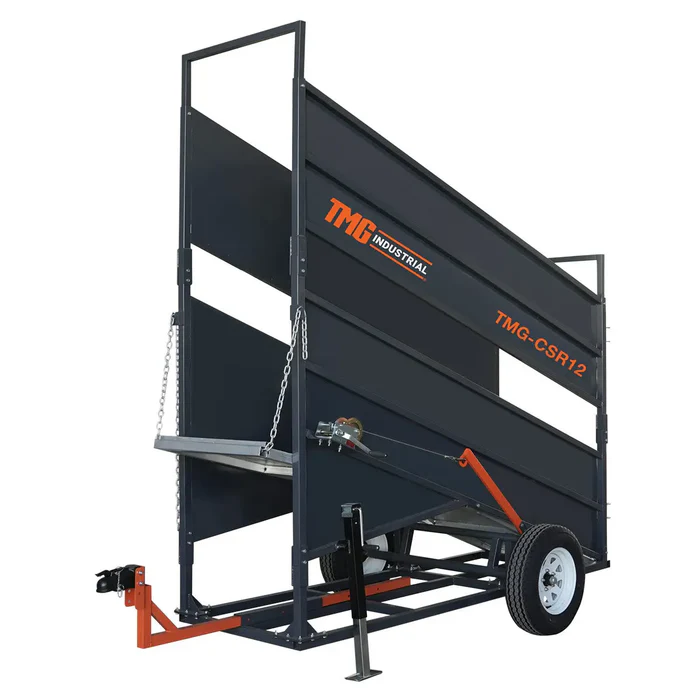
Ramps sort into families by how they adapt and travel. A fixed ramp sets one incline matched to a single trailer height and stays put. An adjustable ramp changes its angle to meet different deck heights, so one structure serves stock trailers, gooseneck rigs, and pot loads alike. Portability adds another axis: a wheeled, towable ramp follows the herd between pens, pastures, and chutes rather than forcing cattle to come to it.
Read for a single-trailer operation in one location, the simplest fixed ramp is light and dependable. Read for an outfit that hauls varied trailers or works scattered ground, an adjustable and portable cattle loading ramp earns its keep, because matching the slope to each trailer keeps the incline gentle and meeting cattle where they stand reduces stressful handling as part of effective livestock handling. The principle never changes: the ramp succeeds by respecting how the animal thinks.
Designed around a safe incline, sure footing, and a quiet field of view, a portable cattle loading ramp turns the most fraught moment of a livestock move into a calm, willing walk that protects animal and handler.
