
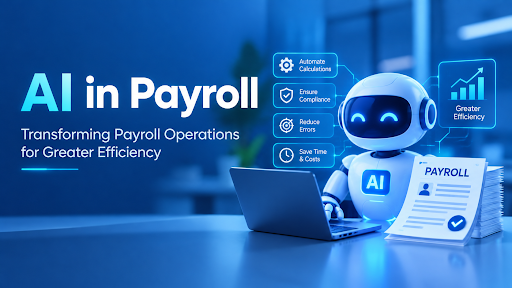

Payroll is evolving from a largely administrative function into a strategic business capability. As organizations manage complex workforces, changing regulations, multiple locations, and growing employee expectations, artificial intelligence is creating new opportunities to improve accuracy, efficiency, compliance, and employee experiences.
The Role of Artificial Intelligence in Payroll
Modernizing Payroll Management
AI payroll capabilities can automate repetitive activities, identify discrepancies, and improve processing efficiency. Organizations implementing AI in payroll can streamline calculations, analyze payroll data, identify unusual patterns, and support faster decision-making while reducing the manual effort associated with traditional payroll processes.
Improving Payroll Accuracy
Payroll errors can affect employee trust, compliance, and operational costs. Intelligent technologies can analyze large volumes of payroll information, identify anomalies, and flag potential discrepancies before processing. This proactive approach helps organizations improve accuracy while reducing the risks associated with manual intervention.
Enhancing Payroll Operations
Modern payroll operations involve multiple processes, systems, policies, and regulatory requirements. Artificial intelligence can support activities such as data validation, employee queries, exception management, reporting, and reconciliation, helping payroll teams improve efficiency and dedicate more time to higher-value strategic activities.
Transforming the Payroll Function
Creating an Intelligent Payroll System
An intelligent payroll system can combine automation, analytics, machine learning, and employee-facing capabilities to create a more responsive payroll environment. Organizations can use these technologies to streamline workflows, identify potential issues, improve reporting, and support more consistent payroll delivery.
Optimizing Payroll Functions
AI can enhance payroll functions by automating repetitive administrative activities and supporting complex decision-making. From data validation and reconciliation to reporting and employee support, intelligent capabilities can help payroll teams reduce manual workloads, improve consistency, and increase overall operational efficiency.
Building a Strategic Payroll Model
A modern payroll strategy should consider technology, workforce requirements, compliance, operating models, data, and employee experience. Integrating AI into strategic planning enables organizations to identify high-value opportunities, prioritize investments, and create a scalable payroll capability aligned with broader business objectives.
Key Benefits of AI-Enabled Payroll
Increasing Operational Efficiency
AI-powered automation can accelerate routine payroll activities and reduce the amount of manual processing required by payroll professionals. Organizations can streamline workflows, improve turnaround times, reduce repetitive work, and redirect employee capacity toward activities that require judgment, analysis, and strategic attention.
Strengthening Compliance and Risk Management
Payroll teams must manage complex regulations, policies, tax requirements, and organizational rules. Intelligent systems can help identify inconsistencies, monitor data patterns, and flag potential compliance issues. This provides payroll professionals with additional insights for managing risks and maintaining more reliable processes.
Improving Employee Experience
Employees expect payroll to be accurate, transparent, and accessible. AI-enabled payroll solutions can provide faster responses to common questions, support self-service experiences, and help employees access relevant payroll information. These capabilities can improve satisfaction while reducing the workload on payroll support teams.
Accelerating AI Adoption in Payroll
Preparing Payroll for AI
AI adoption requires more than purchasing new technology. Organizations should evaluate data quality, existing processes, technology infrastructure, workforce capabilities, governance, security, and business objectives. A structured readiness assessment helps identify gaps and establish the foundation required for successful intelligent payroll implementation.
Managing Change Effectively
Successful AI transformation requires employees to understand how new capabilities affect their responsibilities. Clear communication, training, process redesign, and change management can help payroll professionals adopt intelligent tools confidently while maintaining appropriate human oversight across sensitive payroll activities and decision-making processes.
Measuring AI Performance
AI performance should be measured using meaningful operational and business metrics. Organizations can track processing accuracy, automation rates, resolution times, productivity, employee satisfaction, compliance outcomes, and cost efficiency to determine whether intelligent payroll initiatives are delivering measurable and sustainable value.
Implementing AI-Powered Payroll Solutions
Selecting the Right Technology
Payroll solutions should be selected according to organizational requirements rather than technology trends alone. Organizations should evaluate integration capabilities, scalability, security, data requirements, automation potential, user experience, governance, and total value when determining which intelligent capabilities best support their payroll environment.
Integrating AI With Existing Systems
AI development should account for existing payroll platforms, HR systems, financial applications, employee databases, and enterprise technology. Effective integration enables intelligent capabilities to work alongside established infrastructure, minimizing disruption while creating opportunities to improve automation, analytics, reporting, and service delivery.
Scaling Intelligent Payroll Capabilities
Organizations should begin with high-value use cases and establish a framework for scaling successful initiatives. As capabilities mature, businesses can expand automation, analytics, employee support, and predictive applications across payroll processes while maintaining governance, security, performance monitoring, and operational consistency.
The Role of Payroll Consulting
Developing an AI-Ready Payroll Roadmap
AI consulting can help organizations evaluate their payroll environment, identify opportunities, prioritize use cases, and create an implementation roadmap. This structured approach connects technology investments with business outcomes while addressing process redesign, workforce readiness, governance, integration, and long-term scalability.
Accessing Specialized Expertise
AI consulting services provide organizations with access to specialists who understand both business requirements and emerging intelligent technologies. AI consultants can help assess potential use cases, evaluate technology options, develop business cases, and establish practical approaches for implementing AI across complex payroll environments.
Why Choose The Hackett Group® for AI Consulting & Implementation
Connecting Payroll Strategy With Business Value
The Hackett Group® can help organizations approach payroll transformation through a combination of strategic insight, benchmarking, technology considerations, and transformation expertise. This enables businesses to identify improvement opportunities, prioritize intelligent capabilities, and develop a practical roadmap focused on measurable operational and business outcomes.
Supporting End-to-End Payroll Transformation
Successful AI implementation requires alignment across strategy, processes, technology, people, and governance. The right consulting partner can help organizations move beyond isolated automation initiatives toward an integrated payroll transformation model that improves efficiency, strengthens capabilities, and supports sustainable long-term performance.
Transform Your Payroll With AI
AI is creating an opportunity to redefine how organizations manage payroll. From automating repetitive activities and improving accuracy to enhancing employee experiences and strengthening decision-making, intelligent capabilities can help payroll evolve into a more efficient, responsive, and strategic business function.
Organizations that approach AI strategically can move beyond experimentation and build scalable capabilities that deliver measurable value. With the right roadmap, technology foundation, governance, and expert guidance, businesses can accelerate payroll modernization while preparing their workforce and operations for the future.
